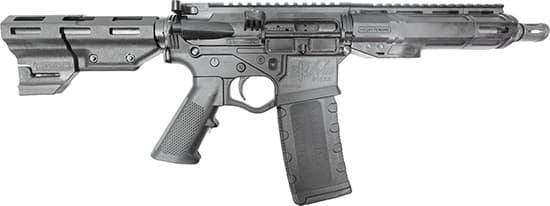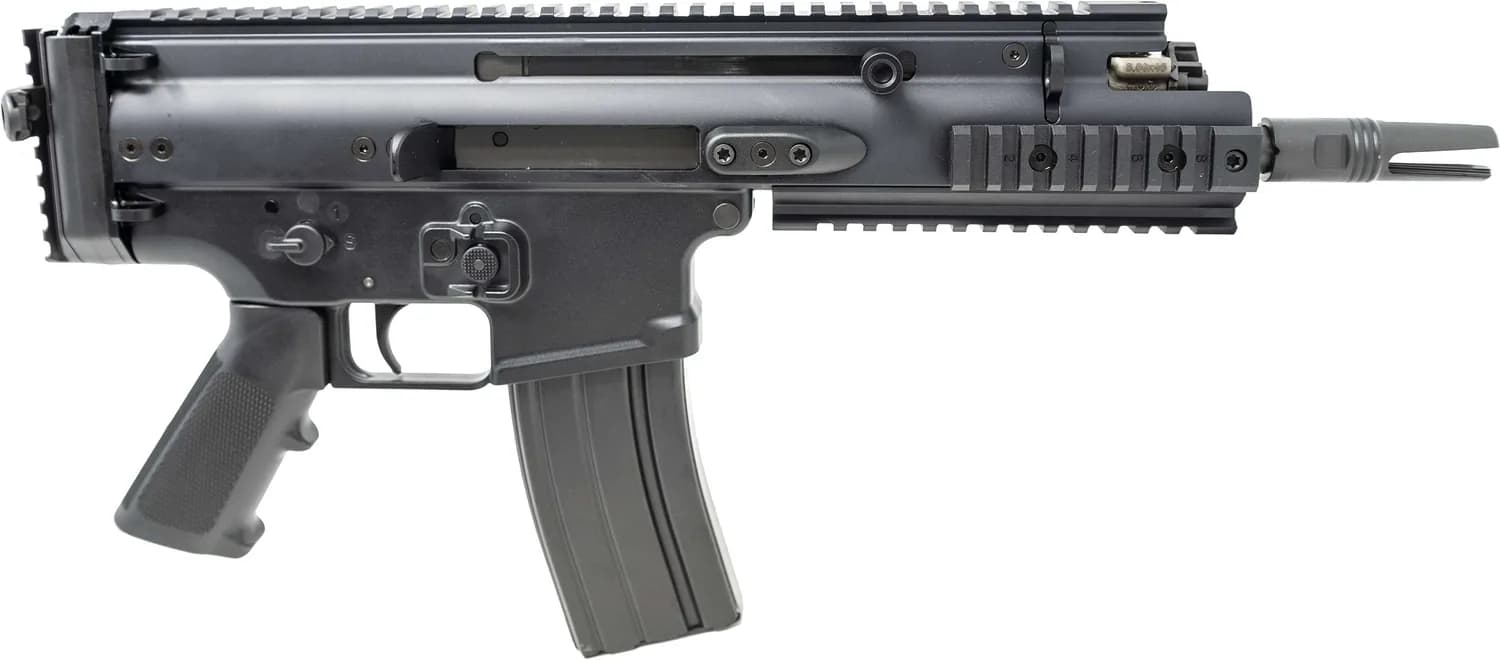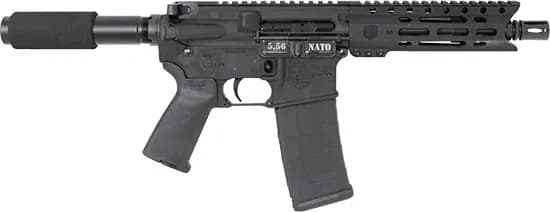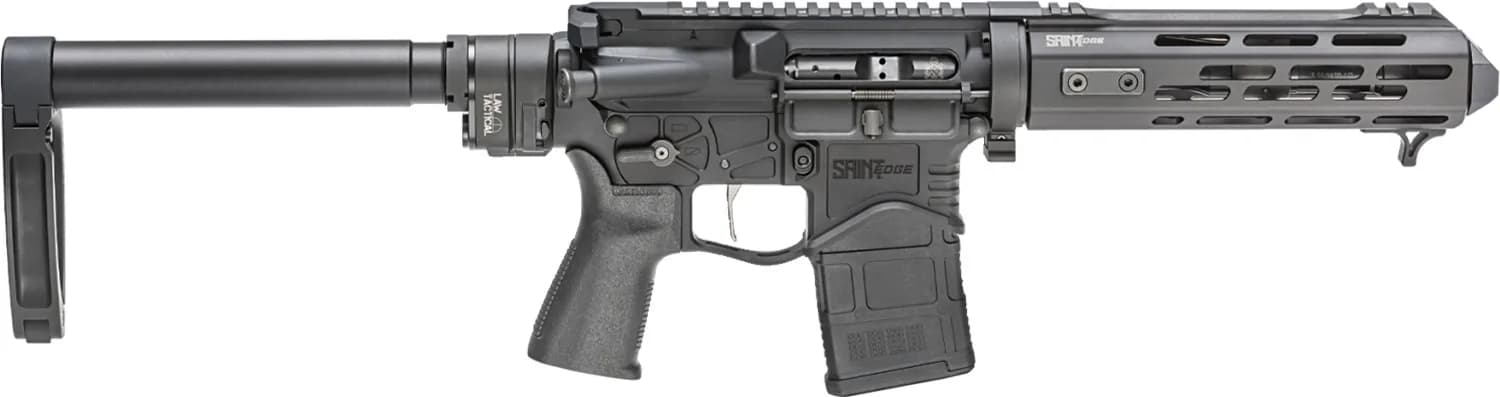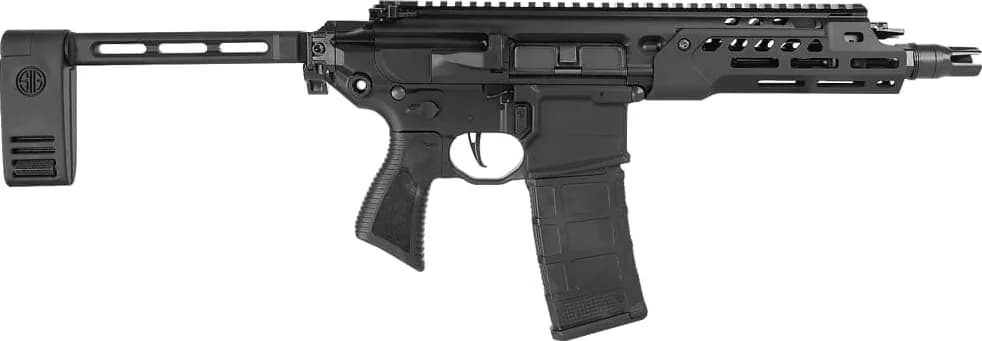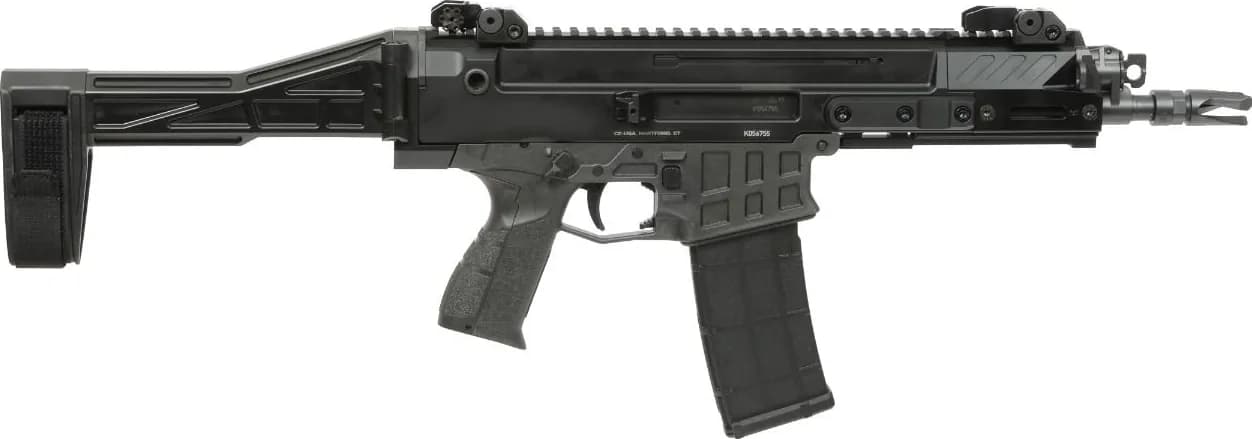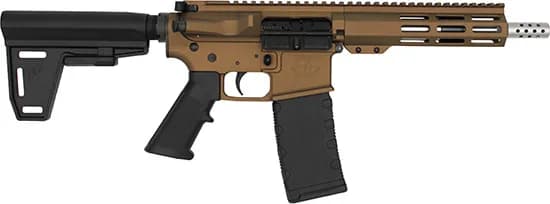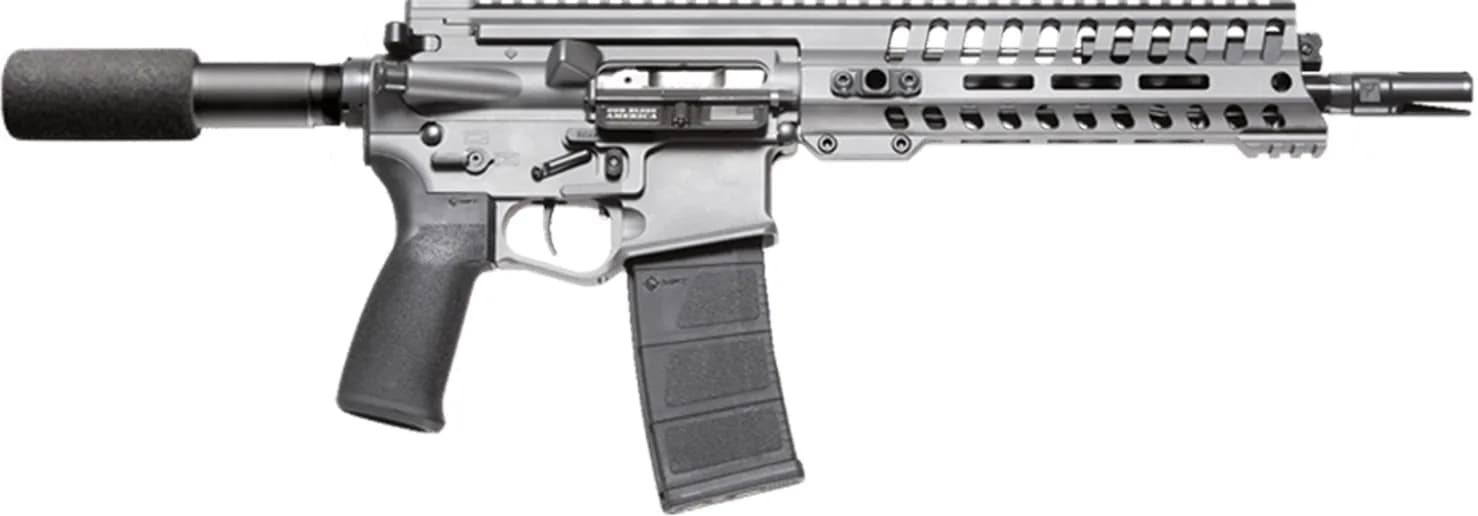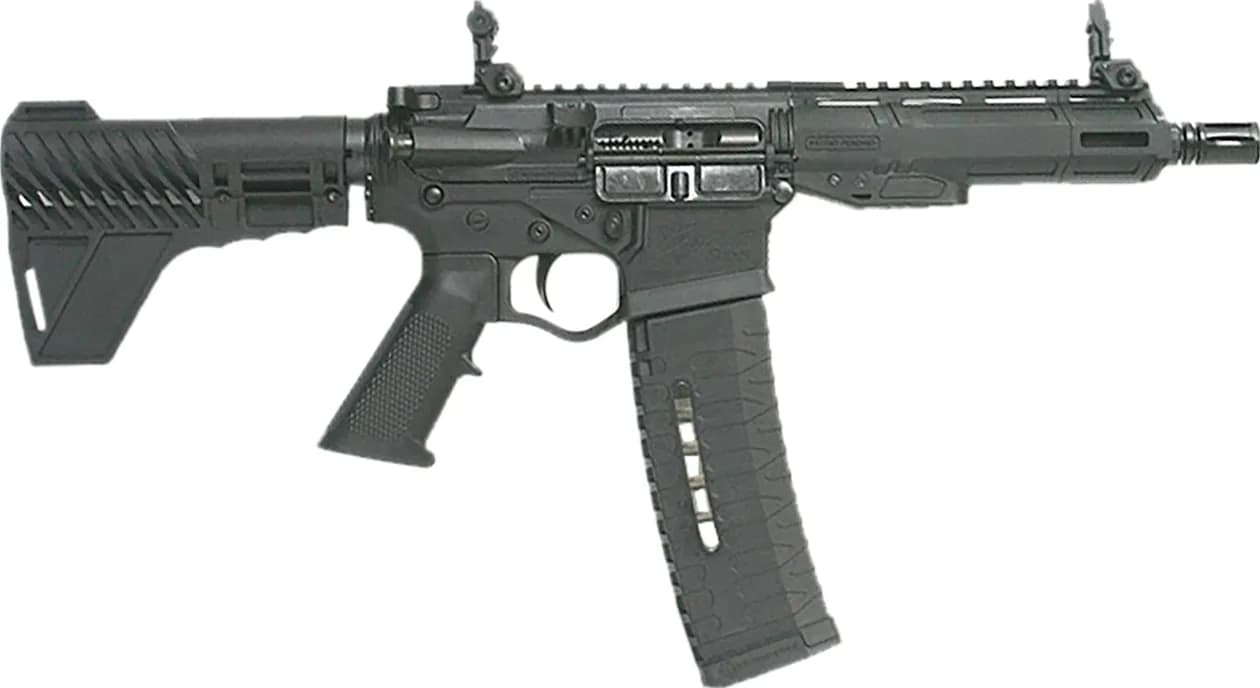
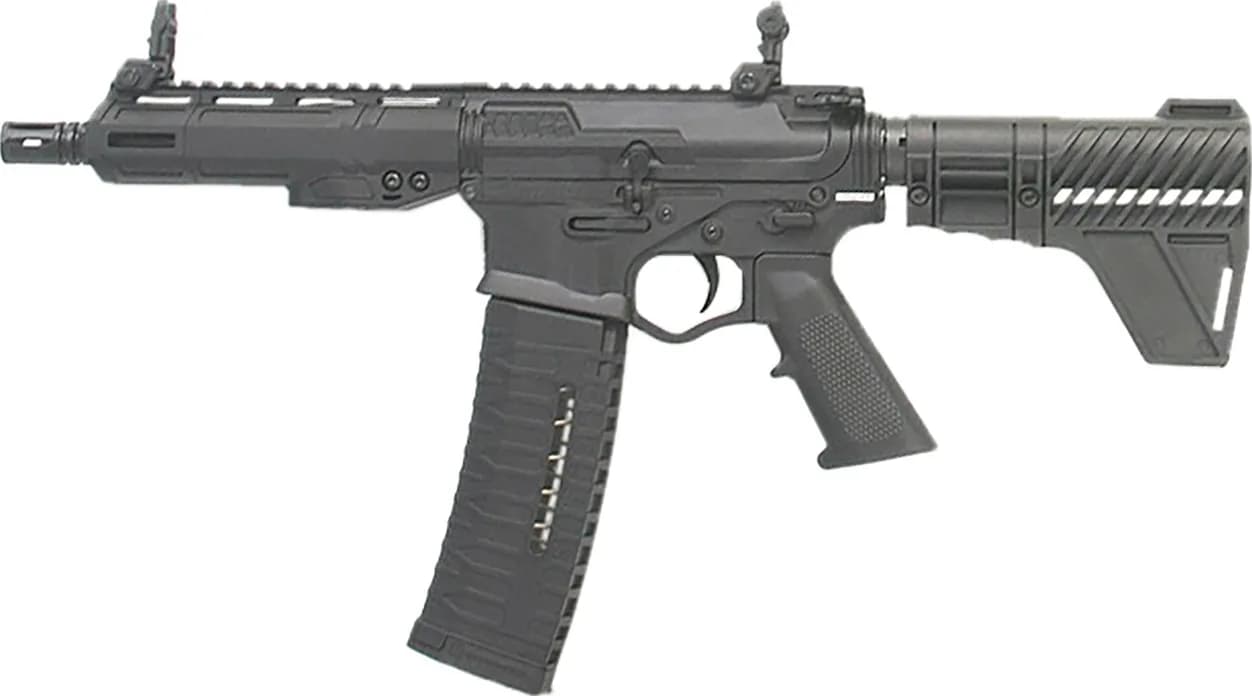
Polymer M-LOK Handguard, A2 Pistol Grip
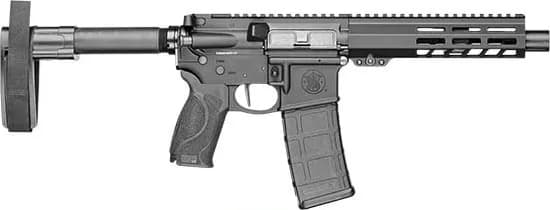
The Alpha Maxx entered the market in the mid-2020s as American Tactical’s answer to an inexpensive, high-capacity AR-pattern “pistol” aimed at shooters who wanted the look and controls of an AR-15 in a compact package. State procurement and regulatory filings show the Alpha Maxx appearing in government and dealer rosters in early 2025, and retail rollouts through that year positioned the model prominently among American Tactical’s handgun offerings. The pistol-grade Alpha Maxx is listed in retailer catalogs and industry inventories as a 5.56/.223-caliber AR-style pistol built around a short (around 7.5-inch) threaded barrel and a 60-round capacity offering, along with an arm-style brace and M-LOK handguard.
American Tactical has long marketed “Maxx” and “Omni/Alpha” variants that mix polymer components and low-cost manufacturing with AR ergonomics; the Alpha Maxx sits in that lineage as a compact, high-volume option intended for recreational shooters, trainers, and buyers looking for a striking, budget-focused tactical pistol rather than a purpose-built precision carbine. Retail flyers and dealer catalogs that list the Alpha Maxx emphasize its compact overall length with brace installed and the included high-capacity magazine as core selling points.
At its heart the Alpha Maxx is an AR-pattern pistol: semi-automatic, chambered in 5.56x45mm NATO / .223 Remington, with standard AR controls, an A2-style pistol grip, flip-up sights, and an arm brace in lieu of a shoulder stock. Dealer and product listings for the model repeatedly call out a polymer M-LOK handguard and a compact, threaded barrel in the 7–7.5-inch neighborhood, and most retailer imagery and spec cards show the Alpha Maxx supplied with a large-capacity drum or drum-style magazine to achieve the 60+1 rating. Those elements define its engineering trade-offs: short-barrel ballistics, compact handling, and an emphasis on visual and magazine-capacity impact over long-range performance.
American Tactical’s construction choices on the Alpha Maxx reflect a budget-first design philosophy. Catalog text and listings show polymer components used in the receiver/stock/handguard assembly on many Maxx variants; that saves weight and cost but typically yields more flex and less rigidity than forged-aluminum receivers common on higher-end ARs. Controls are conventional AR-pattern parts (safety, magazine release, bolt release), and the included flip-up sights and A2 grip keep the interface familiar to AR users. The pistol’s threading at the muzzle allows accessory mounting, but the short barrel length creates well-known compromises in velocity and gas-system tuning for 5.56 ammunition — a factor built into the platform by design rather than oversight.
Performance reports from owners and aftermarket reviewers are mixed, and public forums reflect a split between users who treat the Alpha Maxx as a budget novelty that “does the job” and those who experienced reliability frustrations. Multiple owner threads and community posts document out-of-the-box failures to feed or chamber, the need to experiment with different magazines and ammunition brands, and at least a handful of warranty/service interactions. At the same time, other users report problem-free range sessions after basic break-in and parts swaps. These divergent experiences are common with low-cost AR-pattern pistols where manufacturing tolerances and magazine fitment play outsized roles in function.
From a ballistic and handling perspective, the short barrel is the defining limitation. A 5.56/.223 cartridge loses substantial velocity and terminal performance as barrel length drops below the more conventional 10–16-inch range; shooters and ballistics commentators note that very short AR barrels sacrifice energy and change terminal behavior, making the cartridge less well suited to precision or long-range tasks from a 7–8 inch barrel. In practice this means the Alpha Maxx is most effective at close-range work, fast follow-up shots, and recreational shooting rather than precision marksmanship at extended distances. Accuracy expectations should be modest compared with full-length carbines — the combination of a short barrel, compact sight radius (or use of optics), and a production-level trigger on a budget pistol tends toward practical accuracy rather than sub-MOA precision.
Durability reports mirror the reliability feedback: many owners treat the Alpha Maxx as a light-duty, low-cost platform that will run acceptably with brass-cased ammunition and properly fitted magazines, but those seeking rock-solid, long-term duty reliability or full aftermarket compatibility often end up replacing parts (barrels, gas system components, magazines, or braces) or upgrading to a more robust AR from a mainstream OEM.
The Alpha Maxx’s strengths are straightforward. Its compact length with brace and high-capacity magazines make it a visually bold option for range-focused recreational shooting, “truck” or vehicle-mounted storage where compact size matters, and for shooters who want an AR-pattern experience without the cost of a full carbine. Its light footprint and familiar controls also make it approachable for new AR users who aren’t yet ready to invest in a higher-end build.
Notable limitations steer the pistol away from certain roles. The short 5.56 barrel reduces terminal performance and velocity compared with standard carbines, making it a suboptimal choice for precision shooting or hunting where range and bullet performance matter. Likewise, the model’s more budget-oriented construction and the mixed owner reports mean it should not be relied on as a primary duty weapon without significant user-level upgrades and careful ammunition selection. The heavy, high-capacity magazine setup also changes balance and handling; while that can be an advantage for sustained-fire scenarios at the range, it can be awkward for quick maneuvering or one-handed handling.
The Alpha Maxx occupies a clearly defined niche: it’s a value-oriented, “eye-catching” AR-pattern pistol that prioritizes affordability and magazine capacity. Retailer flyers and dealer catalogs place it in the budget tier of tactical pistols, often undercutting mainstream brand AR pistols on price while including big-capacity magazines and basic accessories to sweeten the package. That positioning has two consequences: it brings AR styling and large-capacity fun to buyers constrained by budget, but it also exposes purchasers to the variability in fit, finish, and long-term durability that often accompanies lower-cost mass-market firearms.
For buyers comparing the Alpha Maxx to similarly priced compact AR pistols, the calculus typically centers on three questions: how important is initial outlay versus long-term reliability, how much modification are you willing to perform, and whether you accept the ballistic compromises of a short 5.56 barrel. Those who want a serviceable, inexpensive range gun with AR ergonomics and high-capacity magazines will find the Alpha Maxx compelling; those who demand proven duty-level reliability or precision performance are likely to look to higher-tier OEMs or to a custom build.
Ultimately, the Alpha Maxx is best understood as a product that delivers a particular set of compromises: compact AR ergonomics and big-capacity capability at an accessible price, traded against short-barrel ballistics and the idiosyncrasies of budget manufacturing. For the right user — someone who treats it as a fun, close-range platform and is prepared for potential tuning or upgrades — it fills a clear place on dealer shelves.
Start with a practical guide if you want a faster way to narrow the field before comparing specific models.
Learn how to choose the right handgun for home defense based on safety, ease of use, and practical everyday considerations.
Read guideBudget-minded buyersLearn how to find a reliable handgun under $500 without wasting money or compromising on quality.
Read guideComparison-focused shoppersA practical guide to comparing handguns the right way: what actually matters, what to ignore, and how to use comparison tools effectively.
Read guide