Affiliate disclosure: HandgunCloud may earn a commission if you continue to the retailer and complete a purchase.
Buy from Impact GunsThe Colt Boa occupies an unusual place in Colt’s modern revolver lineage: an intentionally limited-production model introduced in 1985 that married the visual and barrel characteristics of the Python family to a more production-oriented Colt action. The Boa was created as a special-order offering for a single distributor and was produced in a single run of 1,200 pistols — evenly split between 4.25‑inch and 6‑inch barrels. The complete run sold quickly, and the Boa immediately became a collector’s rarity rather than a mainstream catalog item. Its scarcity and unique place among Colt’s “snake” series have elevated the Boa into one of the most sought-after Colt revolvers among collectors.
In 2026 Colt partnered with a specialty distributor to bring the Boa back as a limited-edition factory Colt offering, reproducing the original aesthetic and packaging for a new run of pieces offered through an exclusive channel. The reissue is positioned squarely as a collectible, limited-production release, echoing the original’s one‑time, small-batch status.
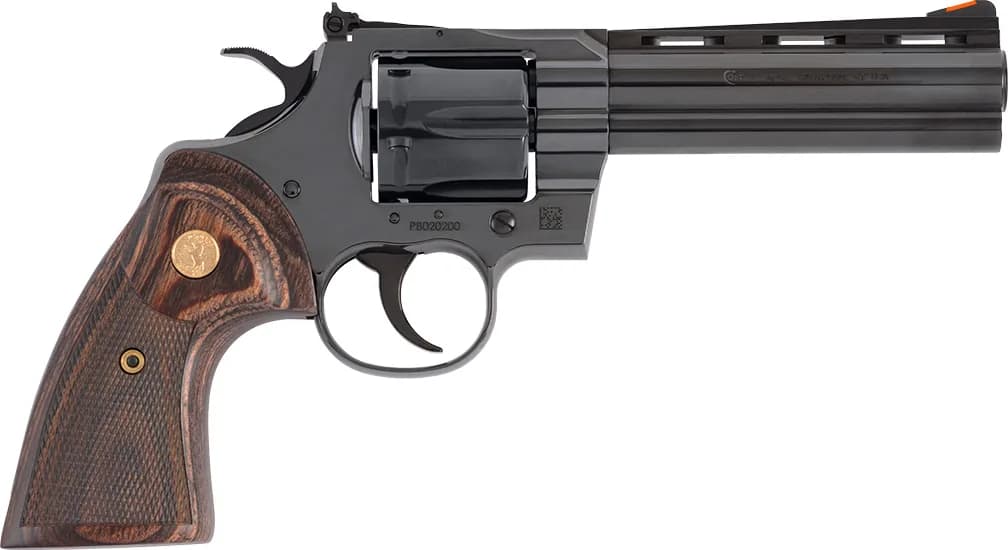
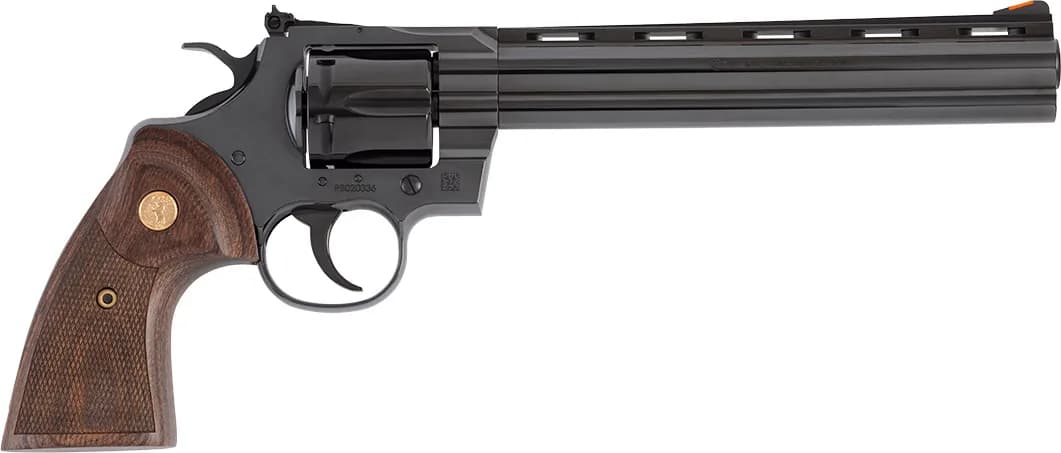
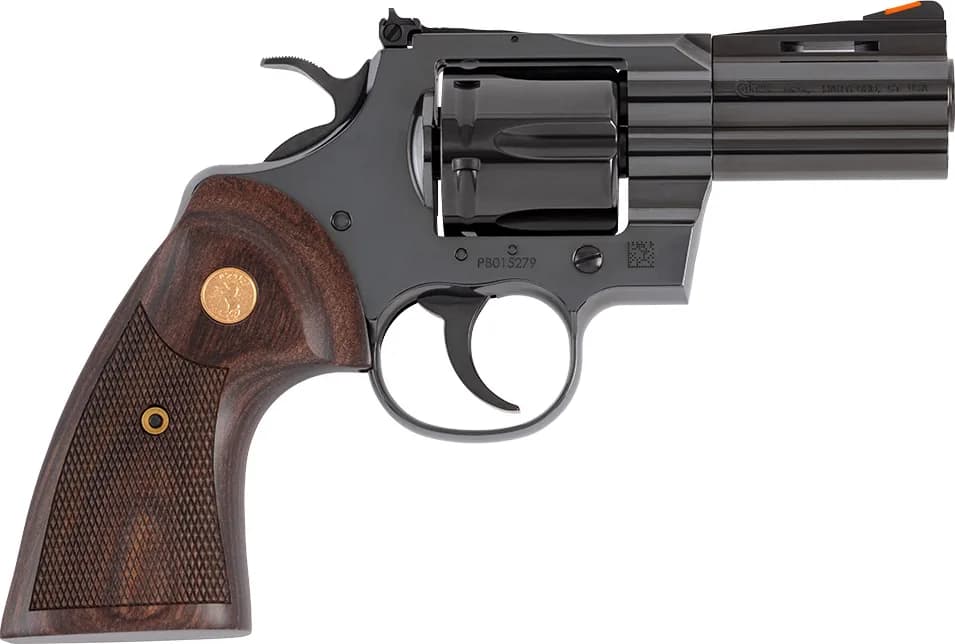
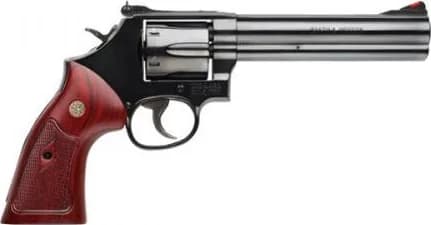
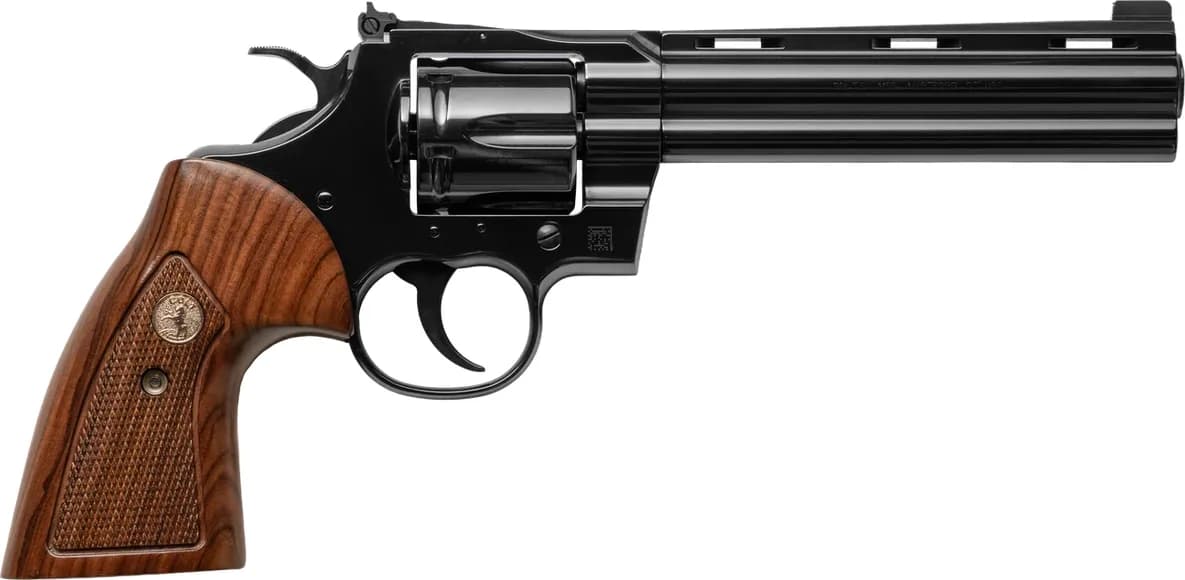
Mechanically the Boa was not a Python in disguise. Colt fitted a Python-style ventilated rib barrel and a full-length ejector rod shroud to a Trooper-derived frame and action — effectively combining the Python’s looks with the Trooper family’s production-oriented internals. That hybrid approach yielded a revolver that visually referenced Colt’s premium “snake” guns while relying on a more modern, easier-to-produce action. Original Boas were delivered with rich blued finishes and checkered Santos rosewood grips with Colt medallions; the reissued pieces replicate those cosmetic cues.
On the 6‑inch configuration, the Boa’s long barrel and full underlug create a front‑end-heavy balance, which many shooters find lends stability for deliberate aiming at the range. The ventilated rib preserves the Python silhouette and provides a familiar sight plane — a brass bead front and an adjustable rear — that favors precision work at distance. Because the Boa’s architecture is steel-on-steel and relatively substantial in mass compared with modern lightweight handguns, the platform typically mitigates felt recoil from .357 Magnum loads better than lighter framed options; that is intuitive from the Boa’s dimensions and traditional revolver engineering. The 6‑shot cylinder and double‑action trigger remain conventional Colt‑style implementations. CNC’s contemporary reproduction lists the same basic feature set (blued steel, Santos rosewood grips, ventilated rib, adjustable rear sight) as the originals, confirming the intent to stay faithful to the 1985 specification.
It is worth noting that the Boa’s mechanical pedigree — a production Trooper action rather than a hand‑tuned Python action — carries direct implications for trigger feel and the level of hand fitting possible at the factory. That design choice is part of the Boa’s historical identity: it looks like a Python but is constructed on a different internal architecture.
Because the original Boa run was produced as a limited, collector‑oriented series, relatively few specimens were used as everyday shooting guns, and detailed long‑term shooting reports are rarer than they are for more widely owned Colt models. Contemporary commentary about the Boa generally emphasizes that it will behave like a heavy‑barrel .357 Magnum revolver: with a 6‑inch barrel and appreciable steel mass up front, the gun tends toward stable tracking and manageable felt recoil with full‑power magnum loads. The ventilated rib and long sight radius favor precise sight alignment, which many shooters associate with good accuracy potential for a revolver of this class.
Where the Boa typically draws comparison to the Python is in aesthetics and sighting, but experienced shooters and historians note that its action will not generally match the Python’s legendary, hand‑fitted single‑ and double‑action smoothness. In other words, the Boa offers solid performance and accuracy potential but is not mechanically identical in trigger refinement to the Python — a fact that informs both how it shoots and how it was originally marketed. Contemporary reissue examples are explicitly factory Colt pieces and are presented as limited, collectible units rather than entry‑level shooters, which suggests buyers seeking match‑grade trigger tuning may still expect some factory characteristics associated with production‑frame revolvers.
Durability for the Boa should align with conventional steel‑frame .357 revolvers; the platform is straightforward and robust when used with appropriate ammunition. Because the original models were quickly absorbed into collections, there is limited public data on long‑term high‑round‑count durability in the way one sees for mainstream service or competition revolvers, but the underlying Trooper‑derived action is a proven, service‑grade lineage.
The Boa’s 6‑inch configuration best suits target and range use where sight radius and barrel length are advantages: precision sighting, silhouette shooting, and controlled single‑action work. Its weight and balance make it a pleasant long‑range revolver for discipline‑oriented shooters and a satisfying steel‑on‑steel handgun for collecting owners who also occasionally shoot their pieces.
As a defensive carry gun the 6‑inch Boa is less practical: its size and weight speak against everyday carry, and the Boa’s contemporary reissues are being marketed with collectors in mind rather than as duty tools. A 4.25‑inch Boa (the original run included a short‑barrel variant) would be more serviceable for duty or home defense in terms of maneuverability, but even then the Boa’s rarity and collectible status historically made most owners reluctant to subject originals to daily service‑use. The reissued limited production continues that emphasis on collectability — buyers typically regard these as showpiece revolvers that can be shot rather than daily‑carry workhorses.
Historically the Boa’s market position has been that of a niche collector’s jewel. The single production run and the weapon’s ties to the Python family have made original Boas highly desirable in auction houses and private sales; prices realized at auction have reflected that scarcity and collector demand. The Boa sits above standard production Trooper or service revolvers in collectability and often compares in desirability to other limited Colt snake guns, even though it was not a Python mechanically.
The 2026 limited reissue positions Colt and its distribution partner to capture that collector market again, offering faithful factory reproductions designed to evoke the original while being explicitly limited in quantity. In the broader market of medium‑frame .357 revolvers, the Boa’s value proposition is not competitive on a purely utilitarian basis versus modern production workhorses from other manufacturers; rather, its appeal rests on heritage, aesthetics, and rarity. For buyers prioritizing shootability and serviceable duty features, contemporary mainstream options remain more practical; for collectors and enthusiasts seeking a historically resonant Colt snake gun with period styling and limited availability, the Boa occupies a distinct and well‑defined niche.
The Colt Boa’s story is therefore twofold: a short, rare original production run that achieved near‑instant collector status, and a modern limited reissue aimed at those same collectors. For anyone evaluating the model, the deciding factors are whether one values the Boa primarily as a piece of Colt history and display, or as a steel‑framed, long‑barrel shooting revolver — and whether that historical cachet justifies the premium attached to ownership.
Start with a practical guide if you want a faster way to narrow the field before comparing specific models.
A practical guide to comparing handguns the right way: what actually matters, what to ignore, and how to use comparison tools effectively.
Read guideFirst-time buyersLearn how to choose your first handgun by focusing on size, comfort, ease of use, and budget instead of getting lost in unnecessary details.
Read guide