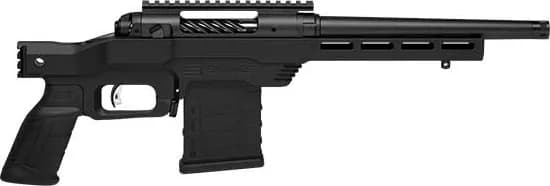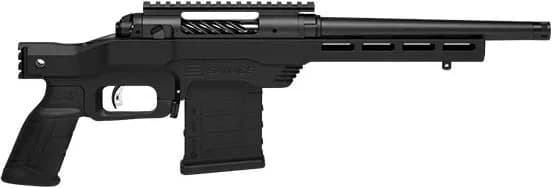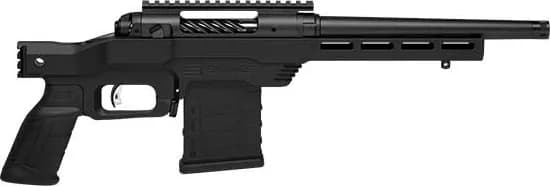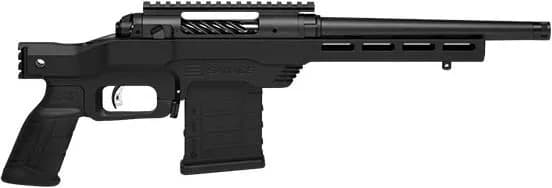
One Piece 0 MOA Rail, Accepts most AR15 Pistol Grips, User Adjustable AccuTrigger 2.5-6 lb, AICS Magazine
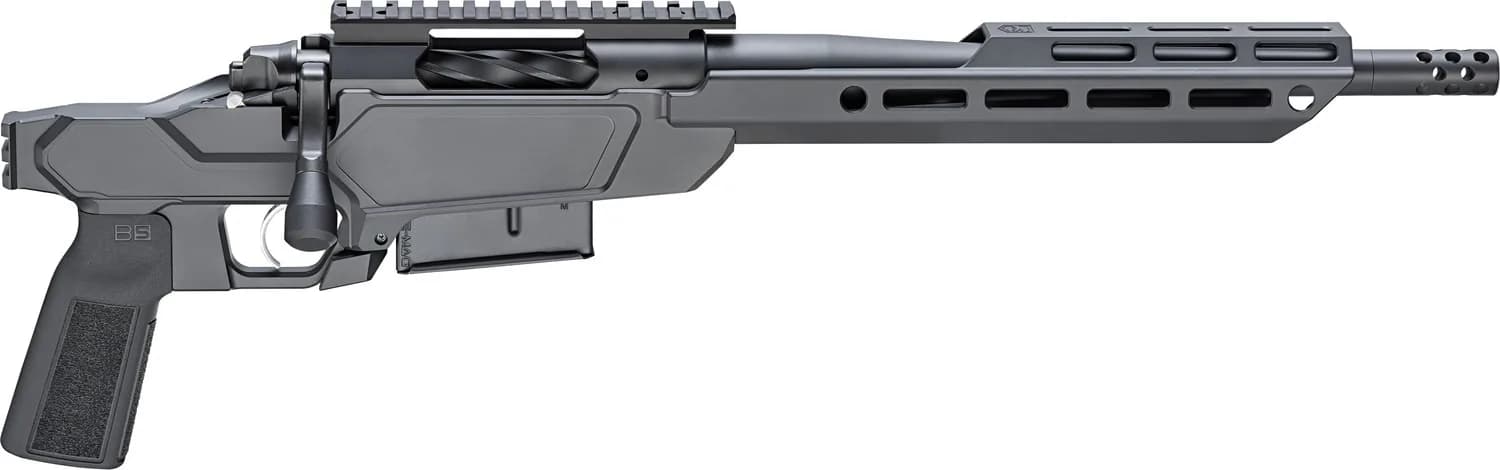
Savage’s 110 Pistol Chassis System (PCS) is a recent entry that transposes the familiar Model 110 bolt action into a purpose-built pistol platform. Announced at the end of 2021 and launched the following season, the PCS was presented as a way to deliver the accuracy, adjustable AccuTrigger and proven action geometry of Savage’s 110 family in a compact, chassis-mounted package available in a variety of chamberings including 6.5 Creedmoor. The platform was developed to appeal to handgun hunters, long-range pistol shooters and anyone who wanted a short, stiff barrel on a blueprinted 110 action without fitting the action into a separate aftermarket chassis. The company ships the barreled action mated to a one‑piece machined MDT aluminum chassis, creating a factory-built chassis pistol rather than a rifle conversion.
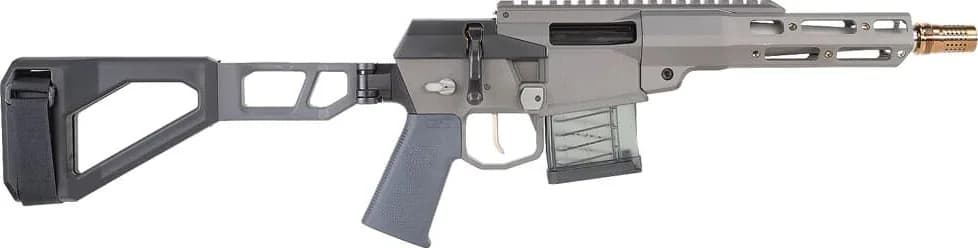
Mechanically the PCS is straightforward: it’s a Savage Model 110 barreled action fitted into a one-piece Modular Driven Technologies (MDT) aluminum chassis with a 10.5‑inch medium-contour barrel and a 0 MOA, one-piece top rail. The chassis incorporates a 7‑inch free‑floating forend with M‑LOK slots, a rear accessory rail and an AICS-style magazine well. The bolt is spiral‑fluted and configured as a left‑hand bolt with right‑hand ejection—an arrangement that lets a right‑hand shooter keep their firing hand on the grip while cycling the action with the support hand. The factory trigger is Savage’s user‑adjustable AccuTrigger, spec’d to be adjustable between roughly 2.5 and 6 pounds. Those features are part of the factory spec for the PCS and are intended to combine the Model 110’s established blueprinting with the rigidity and accessory options of a modern chassis.
That combination of a short, stiff barrel mated to a rigid aluminum chassis influences the pistol’s handling in predictable ways. The compact overall length and relatively light weight (factory figures place it in the mid‑five‑pound range unloaded) produce a pistol that balances forward of the grip, with the chassis’ hard lines and flat surfaces making it well suited to bags, barricade work or being rested on support. The MDT chassis accepts most AR‑15 pistol grips, allowing shooters to tailor the grip shape and angle to personal preference, and the AICS‑style magazine interface provides compatibility with a broad aftermarket of detachable magazines.
On the range the PCS behaves like a short‑barreled, chassis‑mounted precision tool rather than a conventional handgun. The short 10.5" barrel and rifle‑caliber chambering mean the gun produces substantial muzzle blast and a sharper impulse than a shoulder‑stocked rifle of the same caliber; reviewers found that a muzzle brake or suppressor substantially tamed the recoil and muzzle rise, though brakes increase perceived noise. The left‑bolt/right‑eject layout earned praise for ergonomics: it permits a shooter to maintain their firing hand while cycling the bolt with the off hand, which feels natural for many precision pistol drills and hunting shots from rests. In terms of durability the PCS uses the same carbon‑steel barreled action that underpins Savage’s 110 family, and the factory assembly into the MDT chassis creates a solid, repeatable interface between action and bedding.
Independent testing and early reviews have been generally positive about the PCS’s accuracy potential for its class. One hands‑on test program reported a cumulative average group in the low‑to‑mid‑inch range (across a mix of factory loads) from a bench at typical pistol-rested distances — a strong showing for a 10.5‑inch barreled pistol in 6.5 Creedmoor. That same testing measured the AccuTrigger on the sample near the low end of the adjustability range (roughly 2.7 pounds average), with acceptable consistency between pulls. Reviewers who ran extended strings of fire noted that barrel life and throat erosion expectations remain tied to cartridge pressures and use—6.5 Creedmoor is more forgiving than magnum rounds but heavy use will still wear a short, relatively hot barrel more quickly than a long, slow‑burning hunting barrel.
Practical performance depends heavily on accessory choices. Optics with generous eye relief or red‑dot sights are popular fits; reviewers cautioned that traditional rifle scopes with limited eye relief can create an uncomfortable or unsafe cheek‑and‑brow relationship given the compact receiver‑to‑eye geometry, particularly when shooting without a suppressor or with a muzzle brake. When suppressed or braked the platform’s recoil and return‑to‑target characteristics become much friendlier, and shooters reported repeatable hit‑making on paper and steel at intermediate pistol distances.
The PCS is targeted at a few overlapping niches. It’s a purposeful option for handgun hunters who need a centerfire round with longer reach than typical handgun hunting cartridges but cannot shoulder a rifle; the rigid chassis and detachable‑magazine setup also make it attractive to precision‑pistol and long‑range‑pistol competitors who prefer a bolt action. Range owners and enthusiasts who want a compact, chassis‑based platform for experimenting with optic setups, muzzle devices and magazine compatibility will appreciate the factory integration of an MDT chassis.
Limitations are inherent: the 10.5‑inch barrel steals velocity from a long‑barrel 6.5 Creedmoor and changes terminal performance and ballistic drop; muzzle blast and concussion are significant without mitigation; and the pistol form means you don’t have the typical rifle cheekweld and length of pull for consistent shoulder‑supported shooting. For shooters seeking pure long‑range performance or minimal muzzle impulse from a rifle‑caliber round, a short‑action rifle or a pistol configured specifically around subsonic calibers may be a better fit. The PCS also inherits the magazine‑and‑bolt‑form tradeoffs of chassis pistols: it’s built around AICS‑style mags and the bolt/ejection orientation that benefits most right‑handed shooters.
When Savage introduced the PCS it was positioned as an accessible factory chassis pistol that brought a proven, blueprinted 110 action to a market segment that had previously been filled by higher‑cost boutique offerings and custom chassis builds. Early comparisons in press testing pitted the PCS against pricier precision pistols and aftermarket‑built chassis guns; reviewers generally characterized the PCS as a strong value proposition for buyers who want a turnkey chassis pistol without aftermarket fitting headaches. For shooters who prioritize a factory‑integrated chassis, a reliable Model 110 action and the flexibility to fit brakes, cans and optics out of the box, the PCS sits competitively in its class. For those whose priorities are pure long‑range ballistics or minimal muzzle signature from a pistol platform, purpose‑built short rifles or dedicated suppressed pistols may present a more suitable alternative.
Overall, the Savage 110 PCS is a pragmatic implementation of a bolt‑action pistol concept: it packages known Savage action geometry, an adjustable AccuTrigger and a factory‑fitted MDT chassis into a compact firearm that performs well inside the constraints of a short‑barreled, rifle‑caliber pistol. The platform’s strengths—rigidity, parts compatibility, and practical accuracy—are balanced against predictable tradeoffs in blast, velocity and shooter ergonomics inherent to the form factor.
Start with a practical guide if you want a faster way to narrow the field before comparing specific models.
Learn how to choose the right concealed carry handgun based on size, comfort, safety, and everyday usability.
Read guideHome-focused buyersLearn how to choose the right handgun for home defense based on safety, ease of use, and practical everyday considerations.
Read guideComparison-focused shoppersA practical guide to comparing handguns the right way: what actually matters, what to ignore, and how to use comparison tools effectively.
Read guide