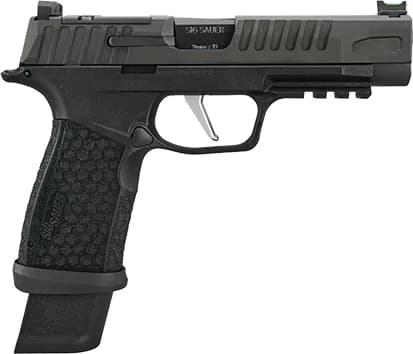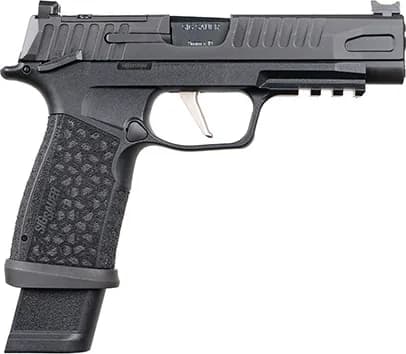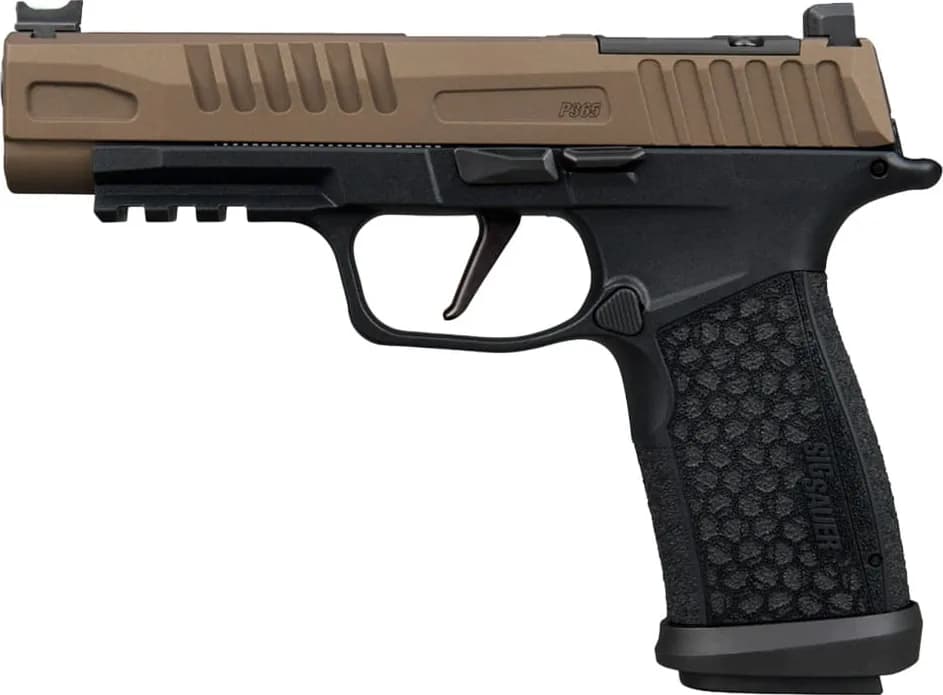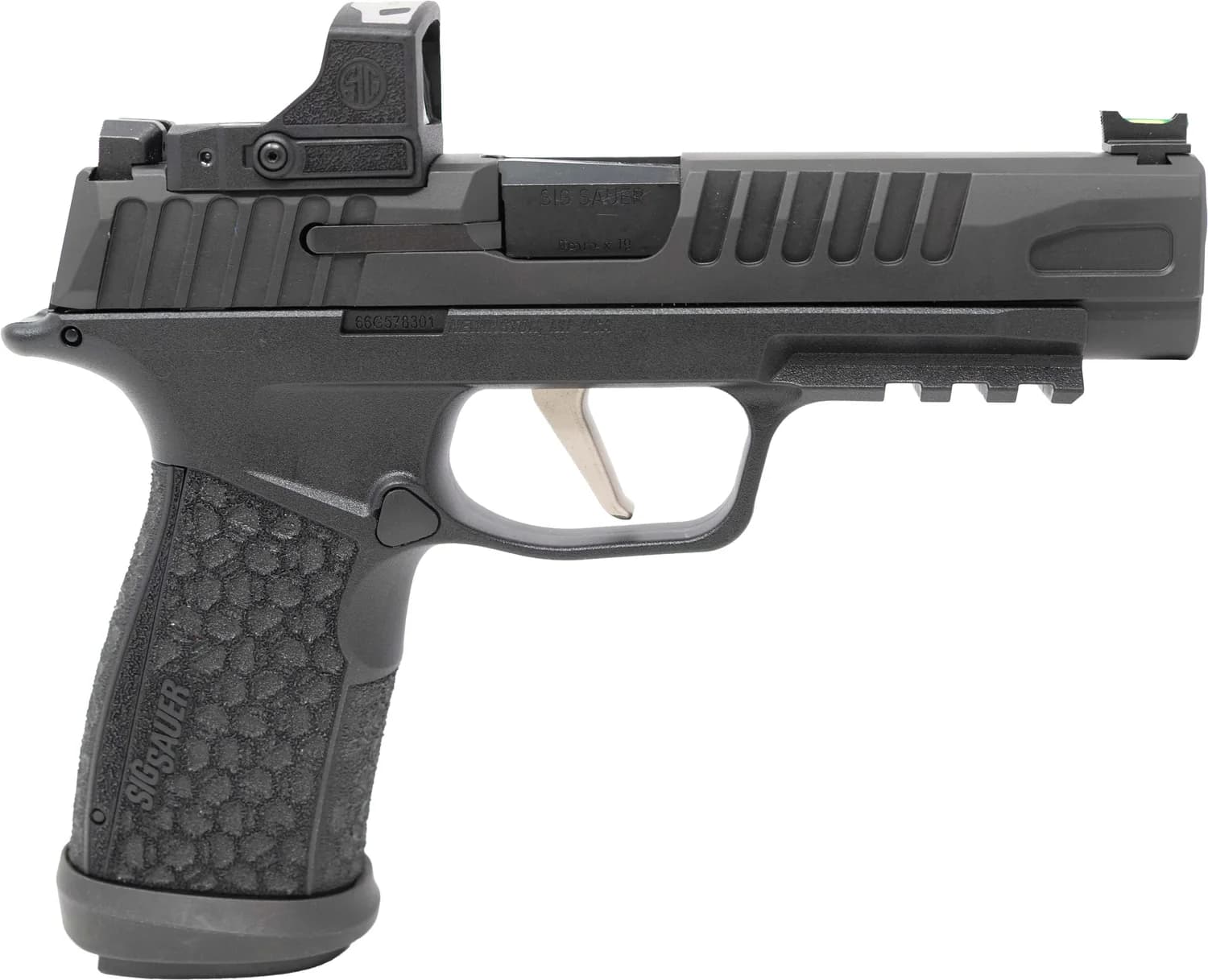
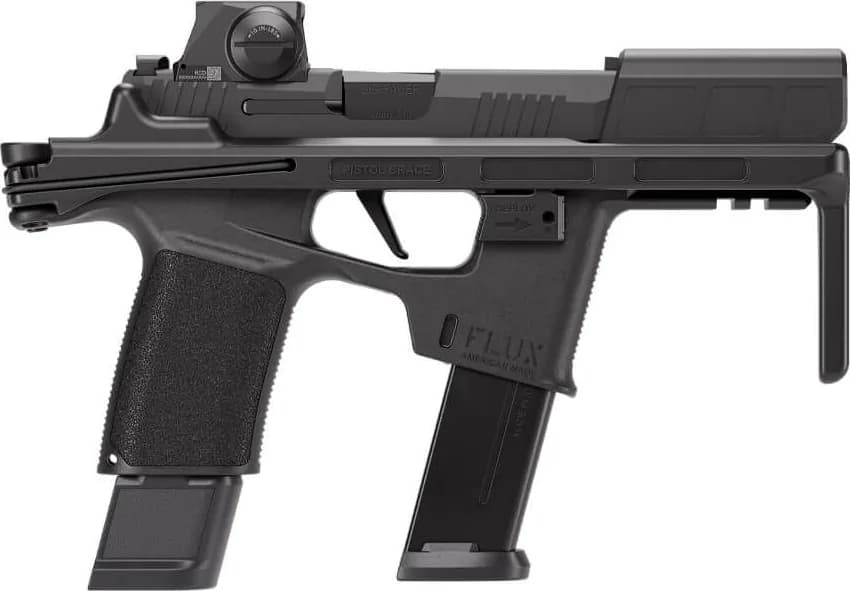
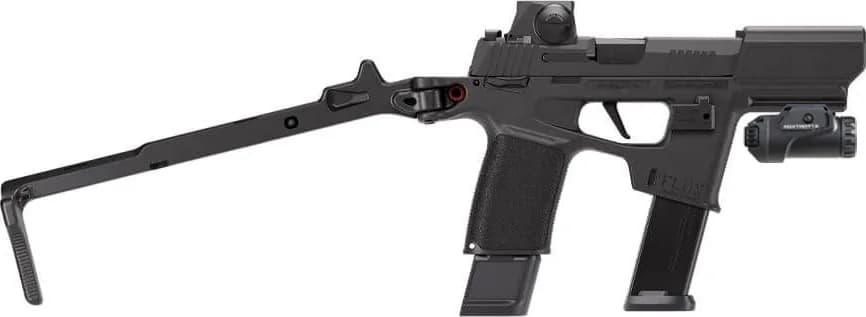
Pistol Brace, Ambi Mag Release & Controls, 1913 Picatinny Rail, Includes ROMEO-X & FOXTROT1X
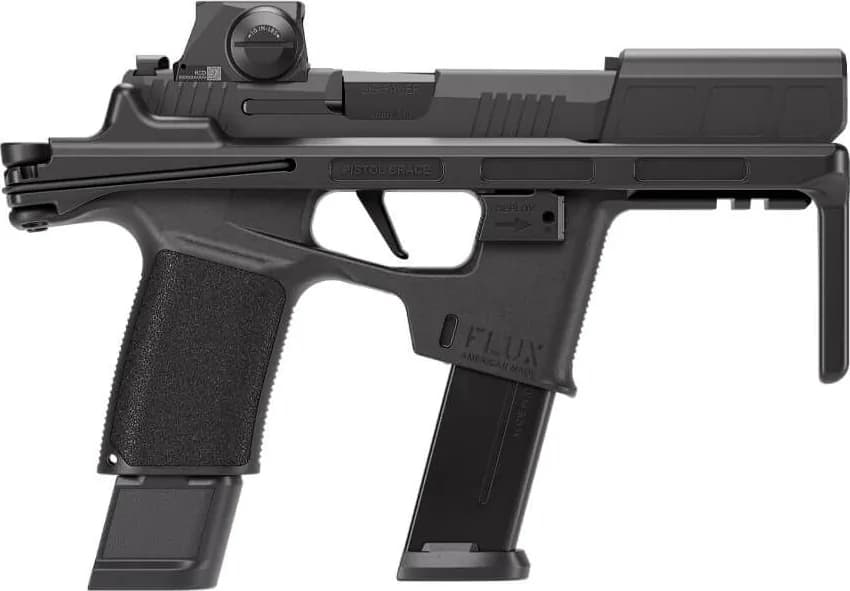
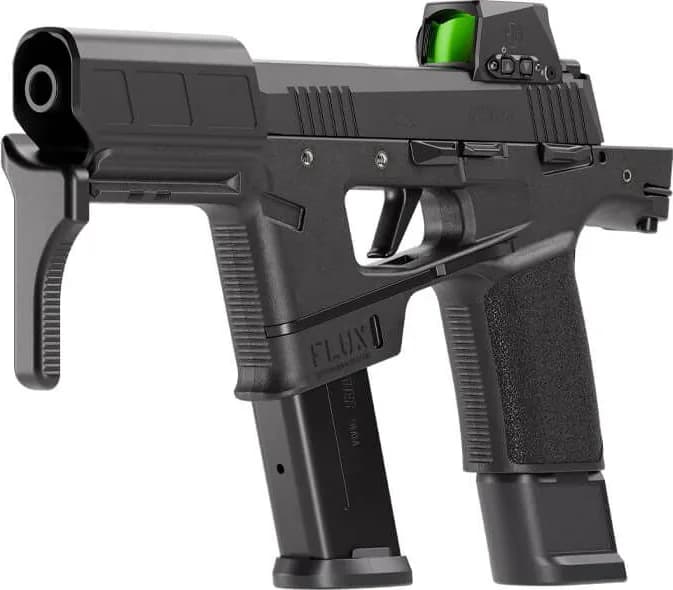
The P365 FLUX is the result of a close collaboration between SIG Sauer and FLUX Defense that takes the compact P365 fire-control unit and builds it into a pistol-caliber PDW-ish package with a folding stabilizing brace, extended barrel and shroud, optics, and higher-capacity steel magazines. SIG first began marketing the FLUX versions of its pistols after Flux Defense’s Raider chassis gained attention as an aftermarket PDW conversion; SIG’s completed P365 FLUX packages began appearing in announcements and catalog entries in mid‑2025 and were in reviewers’ hands by late 2025 and early 2026. The finished product is positioned within SIG’s P365 family as a niche “micro‑PDW” or braced‑pistol variant that deliberately blurs the line between a pistol and a pistol‑caliber carbine while remaining compact enough for concealed carriage in a holster designed for the chassis.
Mechanically the P365 FLUX uses the P365 striker‑fired fire control unit and slide assembly, but it is installed into a purpose‑built Flux chassis that provides a polymer barrel shroud, a 1913 Picatinny rail under the shroud, a spring‑assisted folding brace, ambidextrous controls, and Flux’s dual‑magazine storage/release geometry. SIG’s published operator documentation and product listings for the FLUX show a 6.0‑inch barrel length (the longest OEM P365 barrel to date), overall length around 19.1 inches deployed, and factory inclusion of X‑RAY 3 day/night sights and a mounted red‑dot optic on certain completed SKUs. The completed SIG package is sold with multiple steel magazines (combinations that include 17‑, 21‑, and 25‑round steel mags depending on the SKU) and options that pair different ROMEO red‑dot variants with SIG’s FOXTROT 1X compact weapon light in some bundles.
In practice those engineering choices produce a firearm that handles unlike a conventional compact pistol. The long, shrouded barrel shifts sight radius and mass forward, which improves stability and perceived accuracy, while the shroud and chassis give a C‑clamp or forward‑handhold surface similar to a PCC for better recoil control. The folding brace provides an axial point of contact that, when deployed, turns the platform into a far more stable, two‑hand system than a standard P365. At the same time the chassis’ proximity of the optic and sliding mass to the shooter’s face and the brace frame’s geometry create a unique ergonomics profile that takes time to learn. SIG’s operator paperwork also warns about compatibility limits (barrels shorter than a certain length, aftermarket triggers and components) and documents how the chassis is intended to function as a brace rather than a shoulder stock.
Independent testing and reviews show a consistent theme: the P365 FLUX is not a small pistol given the way it shoots, but it is not a traditional PCC either. Reviewers who ran extended live‑fire sessions reported that, after an initial adjustment period, the FLUX platform is fast and accurate for its footprint — able to hold tighter groups and run quicker follow‑ups than a conventional micro‑pistol thanks to the extended sight radius, forward mass, and stabilizing brace. In competition settings reviewers reported competitive stage times against purpose‑built PCCs in certain scenarios, underscoring how the chassis amplifies the baseline P365’s controllability. That said, many testers also noted the gun’s odd feel in dry‑fire practice, the close placement of the red dot relative to the shooter’s head, and the brace’s tendency to contact the cheek in some holds — all ergonomics issues that require adaptation.
Trigger feel is the familiar striker‑fired characteristic of the P365 family — serviceable and positive for defensive work but not the glassy, light break some PCC‑centric shooters expect. Recoil is described as well‑managed for a 9mm in a compact package when the brace is employed and when shooters adopt a two‑hand, push‑pull technique; with the brace collapsed or used one‑handed the experience reverts toward a large, heavy handgun and is less comfortable for long strings of fire. Early range reports from reviewers and customers who’ve run hundreds of rounds through the factory builds indicate good basic reliability with standard 115–124‑grain 9mm loads; SIG’s own guidance emphasizes using compatible slide and barrel combinations with the Flux chassis to avoid functional problems.
Where the P365 FLUX excels is a clearly defined niche: a compact, concealable system that provides PCC‑like controllability and much higher on‑gun capacity than a stock micro‑pistol while still fitting into a chassis‑specific holster for deep concealment or pack storage. It’s well suited to roles such as a vehicle or “get‑home” kit, a defensive platform for users who want greater controllability and capacity than a standard handgun but don’t want a full carbine, and for recreational shooters who enjoy hybrid PDW platforms. A number of reviewers also found it usable in certain competition environments where speed and compactness are advantages.
Notable limitations are ergonomic and conceptual. The FLUX chassis changes how you grip, mount, and carry the firearm; some shooters find the brace uncomfortable at the cheek and the forward‑mounted optics and shroud can interfere with traditional sight picture habits. The form factor also creates holster and accessory compatibility challenges — buyers must select equipment specifically designed for the FLUX chassis. Finally, because the FLUX occupies a gray area between pistol and PCC, it’s important for buyers to understand legal and practical distinctions for braced pistols in their jurisdiction and intended use. SIG’s documentation and reviewers stress following factory compatibility guidance and avoiding aftermarket triggers or components that can interfere with the chassis’ mechanical safety systems.
The P365 FLUX is a deliberate ecosystem play: it leverages the P365 family’s broad magazine and accessory architecture and pairs it with Flux’s Raider concept to create a product that’s difficult to replicate purely with other manufacturers’ pistols. Compared with dedicated PCCs or larger PDWs, it offers a unique combination of concealability and on‑gun capacity, and compared with a traditional P365 it delivers greater controllability and effective range for many practical shooters. Its value is therefore contextual — for users already invested in P365 mags and accessories or for those who prioritize concealability plus PDW handling, it’s a compelling one‑box solution; for shooters solely seeking the best PCC ergonomics or the lowest price per round, a purpose‑built PCC or larger carbine may represent better raw value. Reviewers place the FLUX as an innovative, somewhat polarizing entry that expands what a P365 can be rather than replacing other classes of guns.
The P365 FLUX is not an incremental variant; it’s a re‑imagining of the P365 platform for shooters who want compact concealability and PCC‑style control in a single factory package. That ambition brings tradeoffs — unique ergonomics, accessory requirements, and a clear need for hands‑on familiarization — but for many users those compromises are an acceptable price for the additional capability built into the chassis.
Start with a practical guide if you want a faster way to narrow the field before comparing specific models.
Learn how to choose the right 9mm handgun based on size, budget, and how you plan to use it.
Read guideHome-focused buyersLearn how to choose the right handgun for home defense based on safety, ease of use, and practical everyday considerations.
Read guideComparison-focused shoppersA practical guide to comparing handguns the right way: what actually matters, what to ignore, and how to use comparison tools effectively.
Read guide