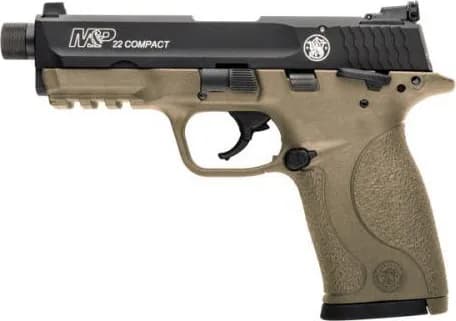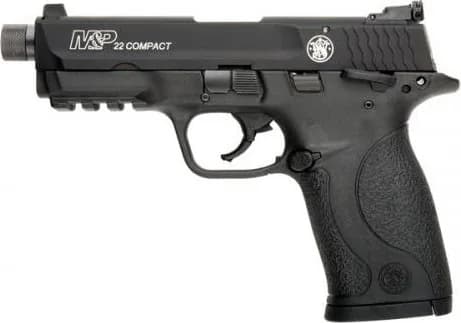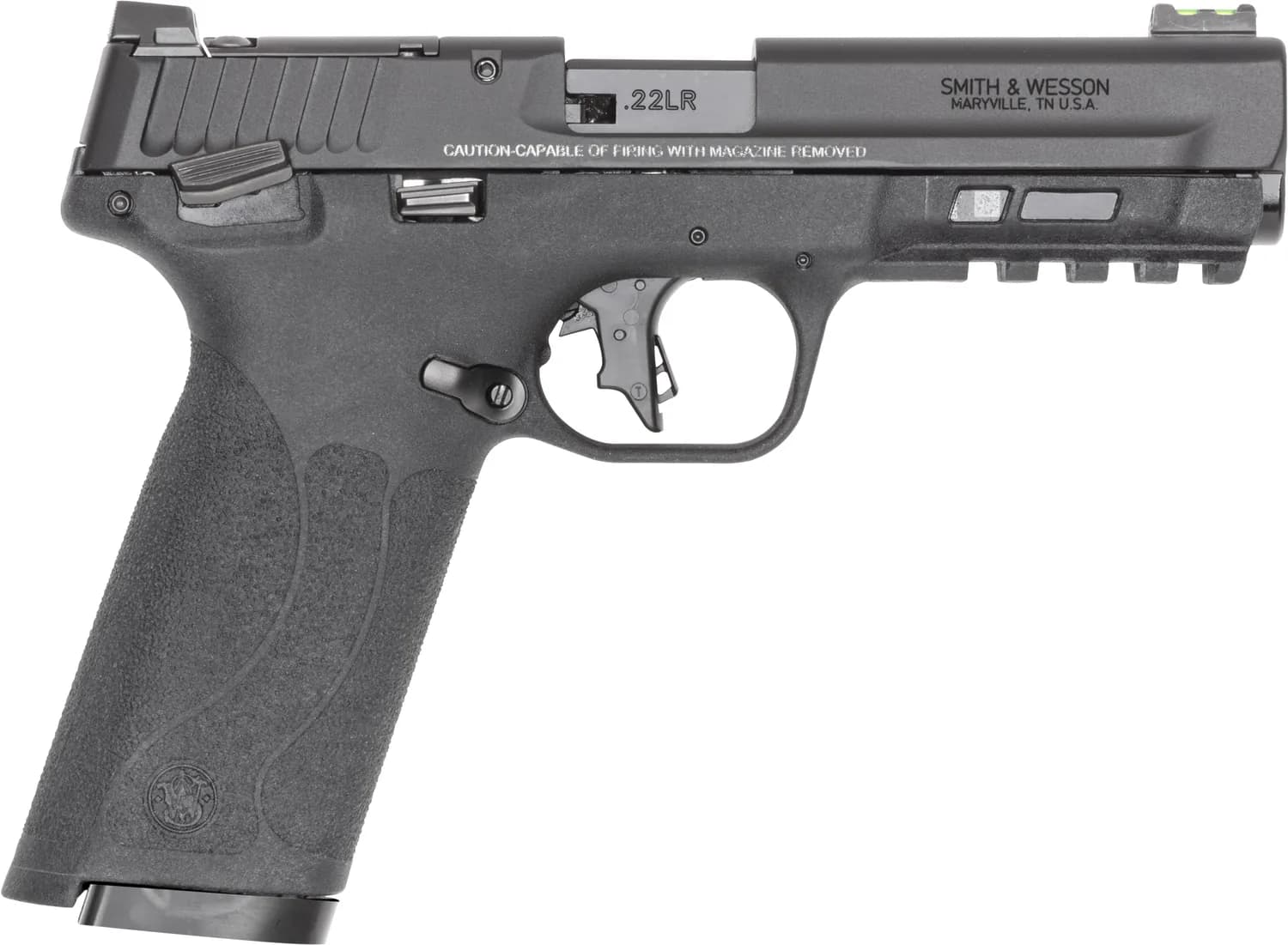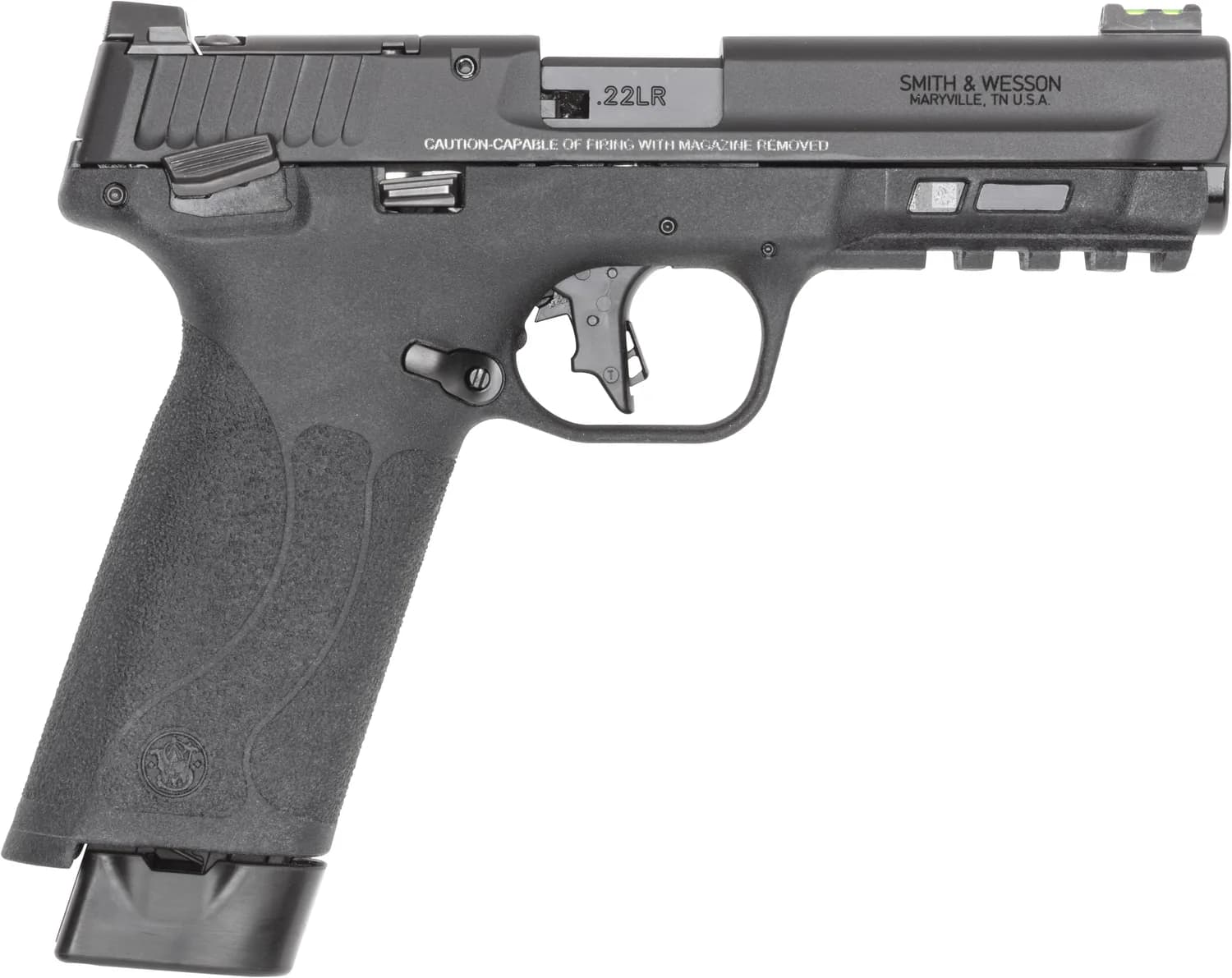
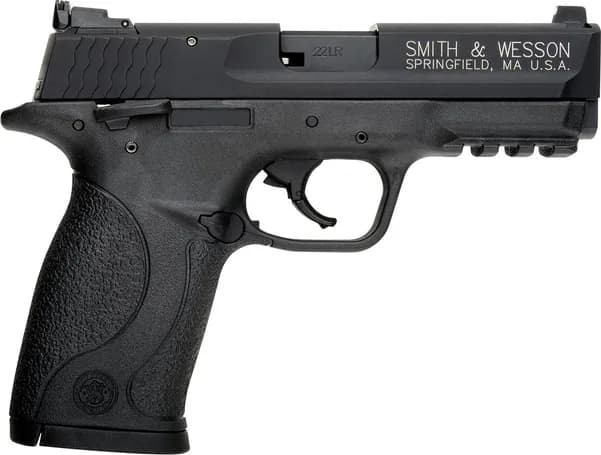
Reversible Mag Catch
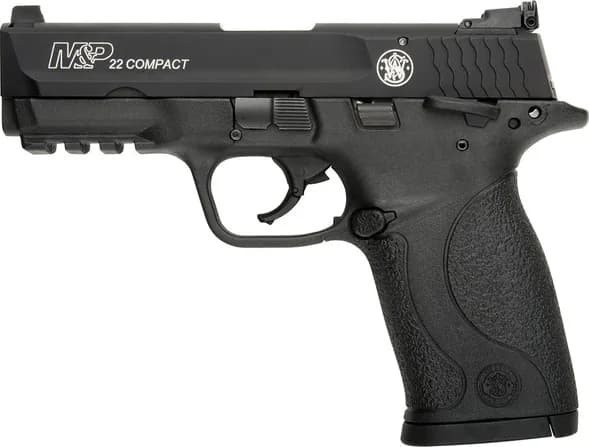
Smith & Wesson introduced the M&P22 Compact to the market in mid‑2014 as a deliberately scaled‑down, purpose‑built rimfire pistol intended to bring the look, controls and handling of the M&P family into a lighter, lower‑cost package. The company unveiled the model in August 2014 and began shipping it that summer; Smith & Wesson positioned the Compact as a “tactical sporting” .22 LR that would serve as a fun range pistol, a trainer for the compact centerfire M&P pistols and a compact rimfire with features uncommon in its class. The Compact differs from the earlier full‑size M&P22 in that it was designed and manufactured entirely by Smith & Wesson in the United States rather than sourced from outside suppliers.
The Compact joined a growing field of scaled‑down rimfire pistols that emulate centerfire ergonomics for training or economical practice. Rather than being a simple plug‑and‑play copy of a centerfire M&P, Smith & Wesson re‑engineered components — slide, barrel, fire control and internals — to suit the rimfire blowback operation while keeping familiar handling cues such as the 18‑degree grip angle and M&P‑style controls.
On paper the M&P22 Compact is a lightweight package: a polymer frame, an aluminum alloy slide and a fixed carbon‑steel barrel result in a pistol that weighs roughly 15.3 ounces and measures about 6.65 inches overall with a 3.56‑inch barrel. It is a single‑action, internal‑hammer, straight blowback design rather than a scaled striker system; the hinged trigger and single‑action feel are intentionally made to resemble the centerfire M&P triggers while remaining appropriate for rimfire operation. The frame includes a molded Picatinny‑style rail, ambidextrous manual safety, reversible magazine release, captured recoil guide rod and a magazine disconnect safety. The barrel is threaded from the factory and shipped with a thread cap for easy suppressor or adapter use.
Those choices translate to perceptible handling traits on the range. The aluminum slide/lightweight barrel balance tames the already‑mild .22 LR impulse and gives the pistol a “real gun” feel without heavy mass. Reviewers repeatedly note the Compact’s comfortable ergonomics — hand‑filling grips, consistent pointability from the 18‑degree angle and a balanced feel that makes follow‑up shots easy. The captured recoil spring and straightforward takedown simplify routine maintenance and make the platform accessible to new shooters. However, because the design uses a magazine safety and a single‑action hammer, it does not identically mirror the operation of every M&P centerfire — training with or without a magazine attached will differ.
Independent testing and publisher reviews place the M&P22 Compact toward the top of the tactical‑style rimfire category for reliability and practical accuracy. Smith & Wesson quoted a factory reliability metric in development testing and invited media to validate it; extended range sessions reported by reviewers showed the pistol running well past 500 rounds with very few stoppages. In one extended test a reviewer recorded a single extraction failure after roughly 530 rounds conducted under mixed conditions and mixed ammunition, a performance that impressed many observers given the variable temperaments of rimfire brass and primers.
Accuracy expectations should be calibrated to the platform and ammunition. Short‑range accuracy testing published by industry magazines showed best five‑shot groups in the low‑inch range at typical pistol distances (Guns & Ammo reported top groups around 1.3–1.8 inches at 10 yards with premium loads; other testing at 15 yards produced roughly 2–2.5‑inch groups), which is competitive for a compact, fixed‑barrel rimfire intended for general training and recreational shooting rather than precision target work. Trigger feel is described as familiar to M&P shooters: a hinged single‑action takeup with a stiffish break in the 5–7 pound neighborhood depending on how sources measured it, with a positive reset that reviewers found acceptable for rapid strings of fire. Recoil is negligible and the pistol’s light weight plus the barrel/slide construction keeps muzzle rise minimal.
Durability impressions in reviews are positive: reviewers praised the quality of the magazines, the construction of the polymer parts and the finish on the aluminum slide. Like most rimfires, the M&P22 Compact will be sensitive to extremely dirty or marginal ammunition, but hands‑on reports show the model to be more tolerant of mixed factory loads than many comparable pistols. The presence of a magazine disconnect and internal lock are sometimes listed as conservative safety features; for some trainers these features are welcome, while for others they represent a constraint on certain dry‑fire drills.
The M&P22 Compact’s strengths are clearest in training, range work and suppressed‑range shooting. Its compact footprint and M&P‑style ergonomics make it a natural practice gun for shooters who carry or shoot full‑size M&P compacts and want a low‑cost, low‑recoil platform to burn rounds and build skill. The factory threaded barrel and included thread protector make it particularly attractive to shooters who plan to use a .22 suppressor for quieter backyard or pest‑control work, and reviewers who tested suppressed configurations reported pleasant noise reduction and retained handling characteristics. For casual plinking and introductory instruction the pistol’s lightweight, adjustable sights and ease of manipulation make it a comfortable choice.
Limitations include the 10‑round magazine capacity typical of many compact .22 autos (some competitors offer higher‑capacity options), and the fact that the blowback, single‑action rimfire operation is not a perfect mechanical analogue for every centerfire M&P. While the Compact is widely regarded as tolerant of a range of factory ammunition, shooters seeking competitive precision at longer distances or long‑term high‑volume match accuracy may prefer purposefully designed target pistols or dedicated match .22 platforms with longer barrels and different sighting/trigger setups.
Within its class the M&P22 Compact sits as a premium‑built, American‑made contender that emphasizes M&P ergonomics and accessory readiness. Competitors in the compact rimfire trainer category include designs such as the Ruger SR22 and the Walther P22 family; those pistols offer similar compact footprints, ambidextrous or user‑friendly controls and comparable capacities, but they differ in manufacturing origin, slide/barrel materials and ergonomics — factors that influence perceived fit, feel and aftermarket support. Reviewers frequently cite the M&P22 Compact’s U.S. manufacture, aluminum slide and threaded barrel as differentiators that justify its positioning as a higher‑spec rimfire trainer compared with some alternatives. For shooters who value M&P ergonomics, suppressor readiness out of the box and a pistol built wholly by Smith & Wesson, the Compact represents a strong value proposition in the tactical rimfire segment.
The M&P22 Compact is not a universal answer for every .22 shooter, but its combination of thoughtful engineering, practical accuracy, and proven reliability make it a standout among compact rimfire pistols designed as both fun range guns and real‑world training tools.
Start with a practical guide if you want a faster way to narrow the field before comparing specific models.
Learn how to choose the right concealed carry handgun based on size, comfort, safety, and everyday usability.
Read guideBudget-minded buyersLearn how to find a reliable handgun under $500 without wasting money or compromising on quality.
Read guideComparison-focused shoppersA practical guide to comparing handguns the right way: what actually matters, what to ignore, and how to use comparison tools effectively.
Read guide