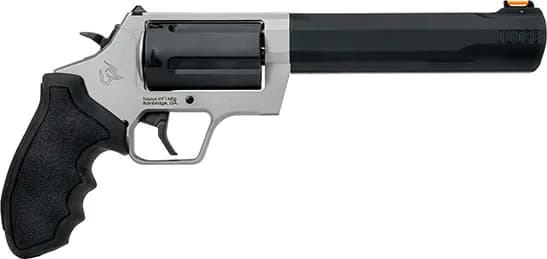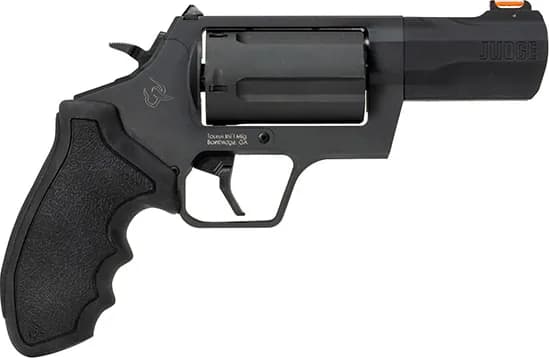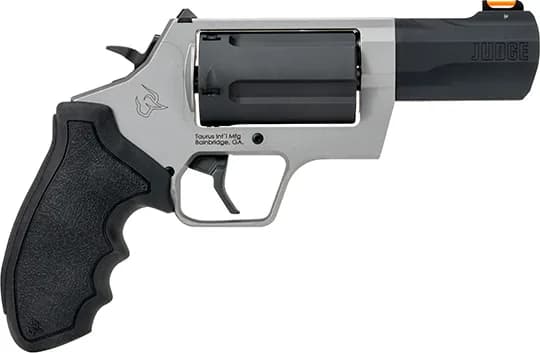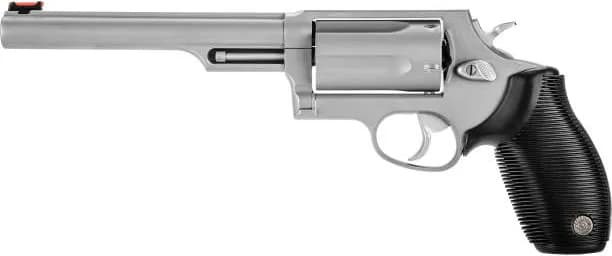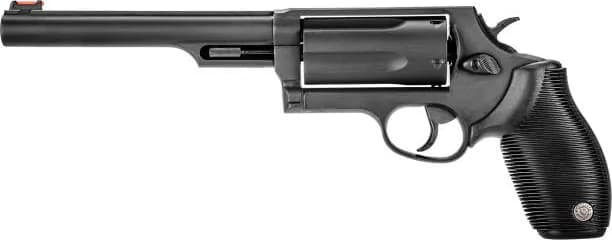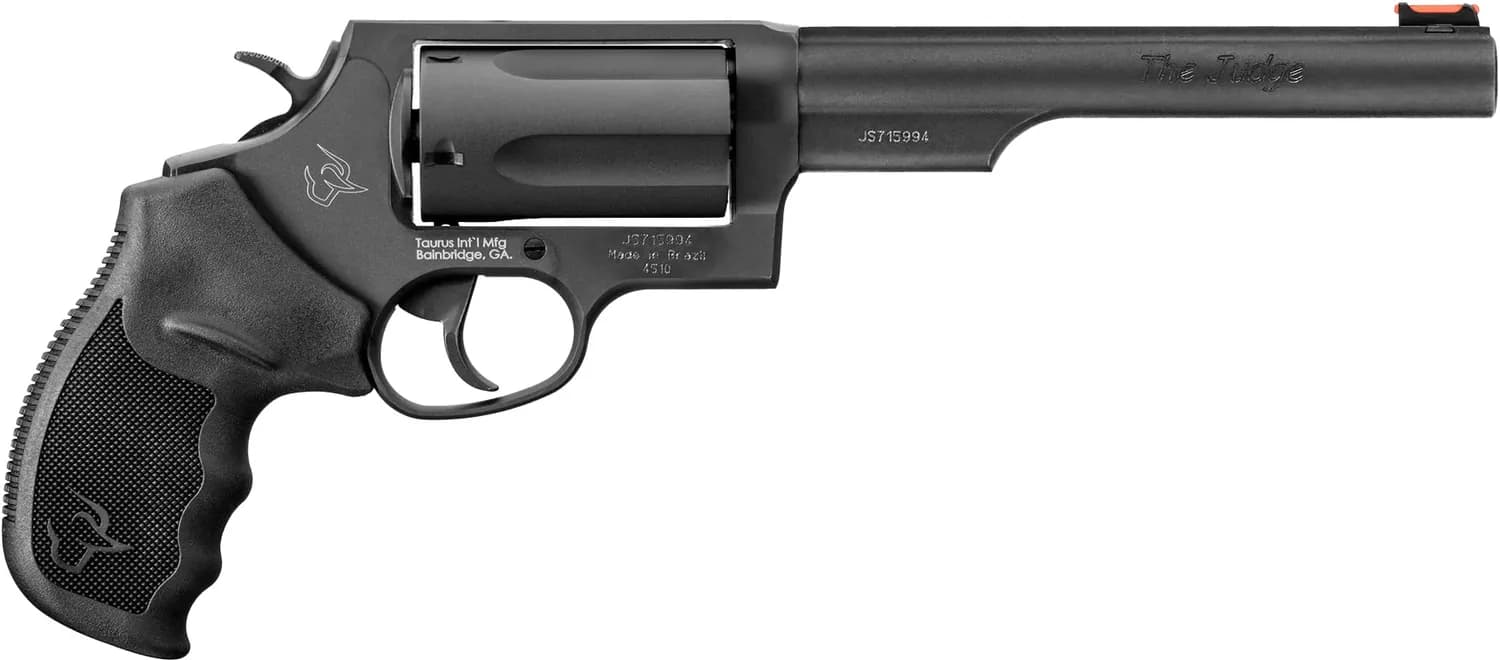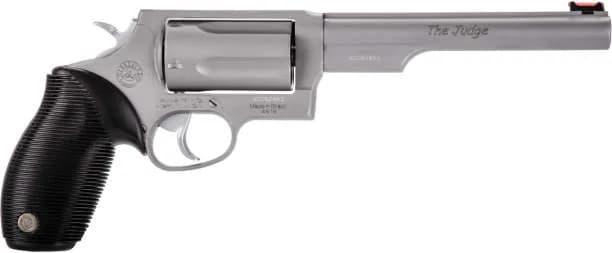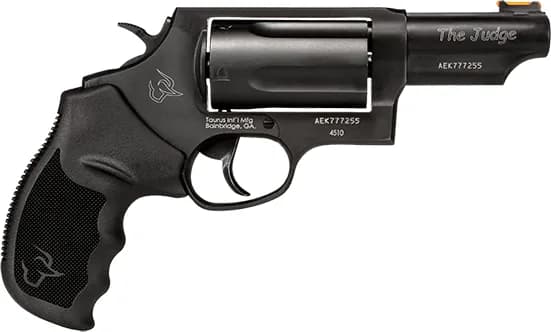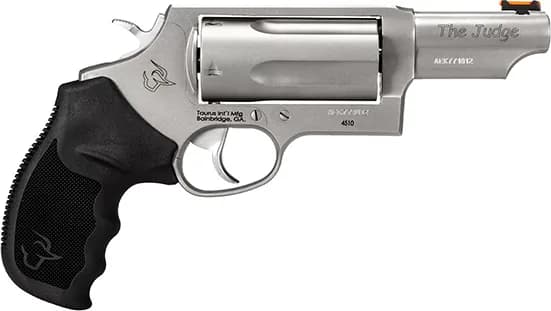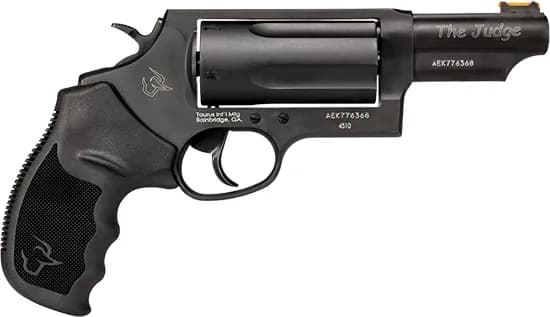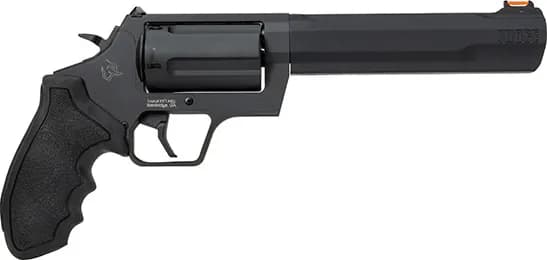
Judge Stamped on the Barrel, Stainless Steel Barrel With Aluminum Shroud
The revolver that became known as the Judge arrived in Taurus’s catalog in the mid-2000s as an unconventional attempt to combine pistol and shotgun capability into a single handgun. The model family was developed from Taurus’s Tracker/medium-frame revolver platform and quickly gained attention for being able to chamber both .45 Long Colt cartridges and .410 bore shotshells from the same five‑shot cylinder. The “Judge” name dates to the company’s early marketing around 2006 and the model has grown into a family that ranges from short, polymer‑frame “Public Defender” carry pieces to long‑barrel variants aimed at trail, farm and home use. Over the years Taurus added heavier “Raging Judge” variants, optic‑ready versions and limited commemoratives, making the Judge one of the company’s most visible and talked‑about products.
In 2026 Taurus refreshed the core Judge lineup with four SKUs, including a 6.5‑inch matte‑black version that keeps the five‑shot .45 Colt/.410 chambering and updates the exterior package — a design aimed at shooters who want the longer sight radius and slightly different handling of the extended barrel without changing the mechanical platform. The refreshed models emphasize improved sights, an ergonomic rubber grip and a redesigned barrel shroud.
Mechanically the Judge is a conventional double‑action revolver: a robust, medium‑frame action, a five‑round cylinder formed to accept .410 shotshells and .45 Long Colt cartridges, and the safety features typical of modern Taurus wheelguns. The current refresh retains a transfer‑bar system and Taurus’s integrated Taurus Security System (TSS) to prevent unauthorized discharge and, in the case of the transfer bar, to prevent hammer‑to‑firing‑pin contact unless the trigger is intentionally pressed. These are factory‑documented features across the Judge family.
The 6.5‑inch variant introduces an arrangement Taurus describes as a stainless‑steel barrel under an aluminum shroud that, on the long‑barrel models, is skeletonized and scalloped to reduce muzzle‑end weight. That approach aims to preserve the rigidity and corrosion resistance of a stainless barrel while using lighter alloy cladding to keep balance and overall handling acceptable for a long‑barrel revolver. The 6.5‑inch version also uses an orange fiber‑optic front post and a removable/drift‑adjustable rear sight that expands practical sight radius and makes the gun more useful for deliberate aimed shots relative to the short‑barrel models. Ergonomically, the 2026 update adds a contoured rubber grip with palm‑swell cushioning intended to tame recoil from hard .45 Colt loads and provide a secure hold while shooting heavy or unbalanced ammunition.
Real‑world handling reflects those design choices: the longer barrel moves the balance point forward but the skeletonized shroud reduces the tendency to feel muzzle‑heavy; the heavier cylinder and frame mitigate recoil, and the ambidextrous, driftable rear sight plus fiber optic front makes target acquisition faster in low light. The revolver’s five‑shot capacity and large cylinder diameter (necessary to accept the shotshells) produce a wider grip circumference than many compact handguns, which some shooters find stabilizing and others find bulky for concealment.
Across decades of testing and consumer reviews the Judge’s performance profile is consistent: it is a versatile and often entertaining gun that carries well‑understood tradeoffs. When loaded with .45 Long Colt, the Judge behaves like a medium‑frame revolver; accurate point‑of‑aim at common defensive distances is achievable with careful ammunition selection and sighting, though the long cylinder and the need for a bullet to travel from the chamber into the forcing cone can limit precision compared with a purpose‑built .45 revolver. When loaded with .410 shotshells the rifle‑style rifling that classifies the Judge as a handgun (and thus avoids shotgun registration rules) interacts with shot payloads in ways that typically produce limited and inconsistent patterns from short barrels — a reality most reviewers emphasize when discussing the platform’s defensive promise. Certain modern handgun‑specific .410 defensive loads pattern better in the Judge than generic birdshot, but pattern performance remains short‑range and load‑dependent.
Trigger feel is model‑dependent and subjective: single‑action pulls on the framed Judge variants are typically light and serviceable for aimed fire; double‑action operation is heavier and deliberate, as with most medium‑frame DA revolvers. Recent Taurus updates claim some geometry changes to refine leverage and smoothness in double‑action pulls, but long‑term shooter experience remains the strongest guide to whether a given sample’s trigger is acceptable. Recoil with standard .45 Colt loads is manageable thanks to the mass of the long‑barrel model and the rubber grip; heavier magnum‑level loads will produce significant impulse and are better suited to the heaviest Judge variants. Durability reports are mixed in the historical record — many owners report long, trouble‑free service, while a minority of reviewers have documented early breakage or extraction difficulties, particularly after extended strings of shotshell use and when lower‑quality hulls are fired. Regular cleaning and conservative ammunition selection reduce those risks.
Where the Judge shines is clear: close‑in defensive use around the home or vehicle, ranch and trail work where flexibility matters, non‑threatening pest control, and recreational range fun. The long‑barrel 6.5‑inch variant widens the appeal toward outdoor uses — snake country, range plinking with shot or slugs, and situations where a longer sight radius and slightly improved ballistic performance from .45 Colt matter. Because the barrel is rifled and the cylinder accepts .45 ammunition, the gun can be loaded with a mix of shot and hard‑bullet rounds to suit varied contingencies.
Its limitations are equally intrinsic: shot payload performance is limited by barrel length and rifling; the cylinder’s size and the grip geometry make concealment difficult compared with modern compact handguns; five‑round capacity falls behind many semi‑automatics; and some owners experience increased maintenance and sensitivity to poor‑quality shotshells. Those realities mean the Judge is rarely the optimal primary carry gun for everyday concealed carry in urban settings, but as a specialty or secondary defensive tool and as a fun, adaptable wheelgun it has a legitimate place.
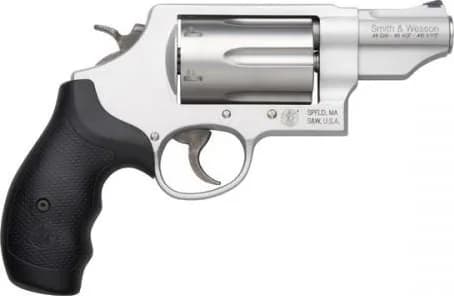
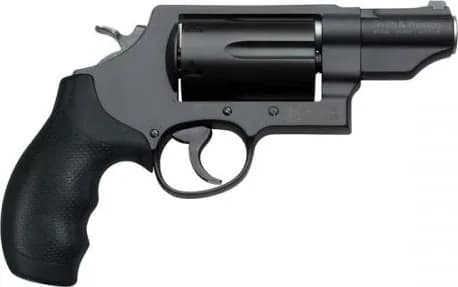
Within the niche of handguns that can fire both .410 and .45 Colt, the Judge occupies a dominant position by virtue of name recognition, product variety and price competitiveness. Its closest established competitor historically was the Smith & Wesson Governor; Taurus has tended to undercut alternatives on price while offering a broader model range and more aggressive variant program. Reputation among shooters is split: many prize the Judge for its novelty, utility and value, while critics point to the platform’s ballistic compromises and the uneven history of Taurus quality control across model years. For buyers who understand the Judge’s strengths and limits — and who match loads, maintenance and expectations accordingly — the long‑barrel Judge is a compelling, characterful option in its class.
The Judge remains, in short, a practical novelty: a well‑known revolver that can be adapted to multiple roles but will never be the best at any single one. For shooters who prize flexibility and the distinctive utility of a .45/.410 revolver, the 6.5‑inch variant represents the most deliberate, sighted and trail‑oriented expression of the concept.
Start with a practical guide if you want a faster way to narrow the field before comparing specific models.
A practical guide to comparing handguns the right way: what actually matters, what to ignore, and how to use comparison tools effectively.
Read guideFirst-time buyersLearn how to choose your first handgun by focusing on size, comfort, ease of use, and budget instead of getting lost in unnecessary details.
Read guide