Affiliate disclosure: HandgunCloud may earn a commission if you continue to the retailer and complete a purchase.
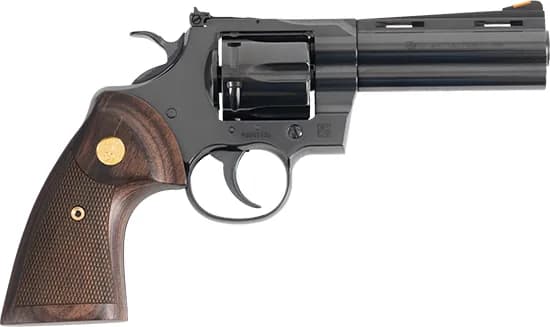
Buy from Impact GunsThe Colt Python needs little introduction: it began life as Colt’s premium .357 Magnum revolver in the mid‑20th century and returned in a modernized form in the 2020s. The original Python (1955–2005) earned renown for fit, finish and a trigger many shooters described as superior among production wheelguns; that reputation made examples from the 1950s–1990s highly collectible. Colt reintroduced the Python as a redesigned, more robust revolver in 2020 and later expanded the offering to include a true blued‑steel, walnut‑gripped 4.25‑inch configuration aimed at buyers who wanted a modern Python finished in the classic style. The blued 4.25‑inch Python is presented as the aesthetic heir to the original “Cadillac” of wheelguns while using updated materials and manufacturing processes to meet contemporary durability expectations.
The modern blued Python with a 4.25‑inch barrel retains the long underlug, ventilated rib and adjustable rear sight that characterize the Python silhouette. Colt’s own documentation lists the 4.25‑inch variant as having an overall length of 9.75 inches, an unloaded weight of about 42 ounces, six‑round capacity and a 1:14 left‑hand rifling twist. The factory ships the blued model with two‑piece walnut target‑style grips and a red‑ramp front sight; the rear sight is adjustable for windage and elevation. Internally, the current Python generation uses a simplified, modernized lockwork compared with the hand‑fitted originals and benefits from stronger steels and slightly re‑shaped mainspring geometry to improve longevity under magnum use. Those engineering choices were intended to deliver the classic Python handling while avoiding some of the durability limits that could appear with heavy magnum use on earlier Pythons.
Ergonomically the 4.25‑inch Python sits in that sweet spot between compactness and sight radius: the balance of the underlug and the relatively heavy all‑steel frame gives a stable, steady presentation on target. The walnut grips are target‑style and a touch fuller than modern slim polymer stocks; many reviewers note they present a comfortable, palm‑filling surface for firing from the bench or for slow, accurate follow‑ups, but shooters with very small hands may prefer slimmer aftermarket panels for extended double‑action strings. The blued finish and walnut furniture reflect a tradition‑first approach—visually compelling but requiring a little more care than stainless for long‑term holster or outdoors use.
Reviews from experienced test shooters make two consistent points: the new Python is very accurate for a production revolver, and its trigger—while not always identical to every prized vintage example—remains one of the Python’s defining strengths. Independent testing of the blued 4.25‑inch model produced repeatable accuracy: five‑shot group averages at 25 yards with a variety of factory .357 and .38 Special loads commonly fell into the 1.5–3.5‑inch range depending on load, with an aggregate accuracy in the mid‑2‑inch range across multiple loads. That level of precision is aided by a tight cylinder‑to‑barrel fit, a recessed target crown and the Python’s sighting geometry.
Measured trigger pull weights for production blued 4.25‑inch examples have varied between testers, but published examinations of the blued Python show single‑action breaks in the neighborhood of roughly 5–5.5 pounds and double‑action pulls in the high single digits to around 11 pounds on the samples tested. More important than a single number is consensus: testers describe a smooth, even pull with a clean single‑action break and a consistently driven double‑action that “rolls” through rather than stacking harshly—precisely the characteristic that made earlier Pythons celebrated.
Durability and reliability were a major design focus for the reintroduced Python. Early pre‑production demonstrations highlighted a handful of soft‑strike and timing issues that Colt addressed before and during ramped production—changes ranged from small lockwork adjustments to confirmed torque practices for sideplate screws and revisions to mainspring geometry. Subsequent production samples and multiple range tests run hundreds of rounds without functional failures, and reviewers reporting extended shooting sessions generally found the revised parts and modern metallurgy improved robustness compared with some historical examples. That said, like any new production run, a small number of early customer reports prompted factory service visits; Colt publicly and in community forums has worked to address those concerns rather than leave them unresolved.
The blued 4.25‑inch Python occupies a few overlapping niches. It excels as a range and target revolver: excellent sights, solid barrel harmonics and a refined trigger make it well suited to precision work on paper and steel at common handgun distances. It is also an attractive choice for hunting or heavy‑duty shooting where a stout .357 Magnum revolver offers flexibility in load selection. Historically the 4‑inch/4.25‑inch Python was a favored duty piece, and while the modern Python is certainly competent for defensive use, its size and weight make it less attractive for daily concealed carry compared with compact semi‑autos or lighter revolvers. The blued finish and walnut grips lean more toward collectible‑grade presentation and range appearance than austere duty hardness—owners who plan regular carry or heavy use in adverse conditions often prefer stainless variants or protective finish treatments.
Limitations are straightforward: an all‑steel, 42‑ounce revolver is not optimized for deep concealment; the heavier single‑action break relative to tuned custom examples means competition shooters who demand ultra‑light triggers may still send their Python to a gunsmith. Finally, blued finishes show holster and weather wear more readily than stainless, which matters for owners who prize a pristine appearance.
The modern Python is squarely a premium, heritage‑focused product. Colt has positioned the blued 4.25‑inch Python as the modern heir to the classic production snakes—delivering classic form, contemporary metallurgy and production processes. Compared with similarly sized heavy‑frame .357s from other makers, the Python’s selling points are aesthetic pedigree, fit‑and‑finish, and the characteristic Python trigger feel; competitors that offer strong value in the same category emphasize ruggedness, aftermarket parts support or lower price points. For buyers valuing the combination of collectible styling and turnkey accuracy, the blued Python is competitive; for those prioritizing the lowest purchase price or the lightest carry package, there are less expensive or lighter options. The reintroduction also serves to cushion and in some cases reduce the market pressure on vintage examples—modern Pythons give shooters a “new” Python experience without paying collectible premiums.
The current Colt 4.25‑inch blued Python is therefore best understood as a carefully re‑engineered classic: it preserves the elements that made the Python famous—appearance, balance, accuracy and a refined trigger—while applying contemporary metallurgy and quality‑control lessons so the old charm better survives modern use.
Start with a practical guide if you want a faster way to narrow the field before comparing specific models.
Learn how to choose the right concealed carry handgun based on size, comfort, safety, and everyday usability.
Read guideHome-focused buyersLearn how to choose the right handgun for home defense based on safety, ease of use, and practical everyday considerations.
Read guideComparison-focused shoppersA practical guide to comparing handguns the right way: what actually matters, what to ignore, and how to use comparison tools effectively.
Read guide