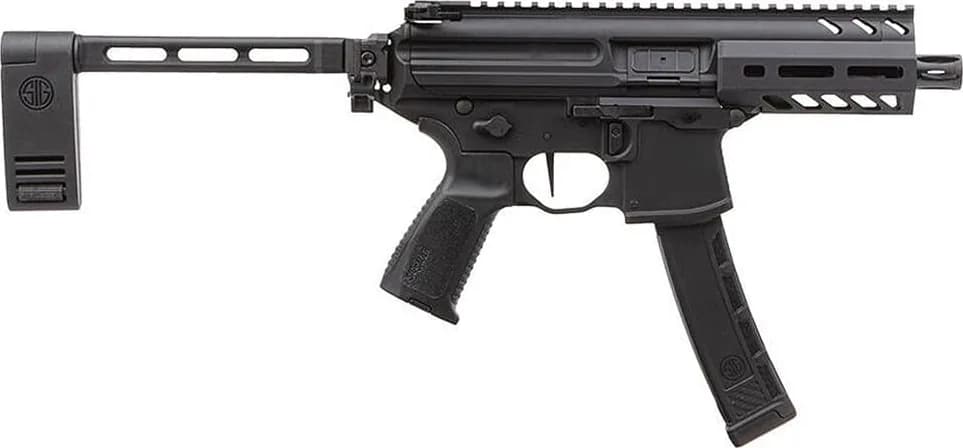
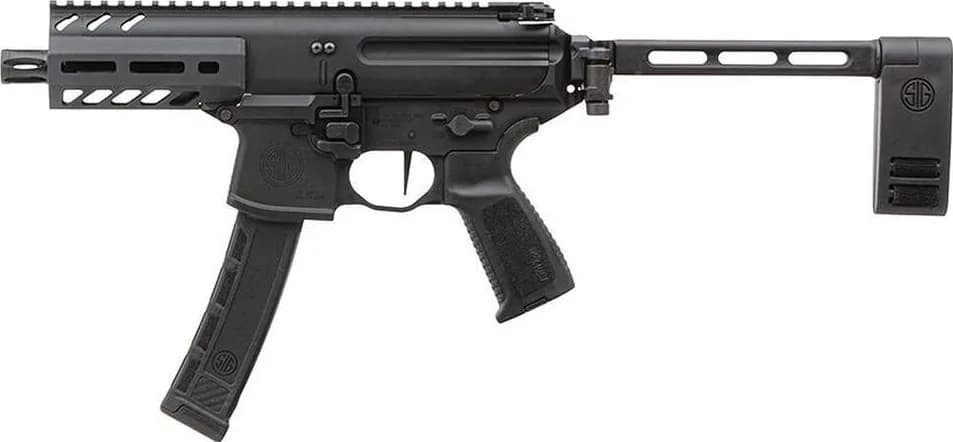
Flat TIMNEY Single Stage Trigger, 5/8x24 Threaded Barrel, Folding Pistol Cane Brace
The MPX family began as SIG Sauer’s purpose-built pistol-caliber platform, conceived in the early 2010s and publicly introduced as a civilian/semi‑automatic line during the mid‑2010s. The MPX was engineered around a short‑stroke gas piston and a closed rotating bolt to deliver locked‑breech performance in 9mm while preserving the ergonomics and modularity of an AR‑style chassis. The MPX K is the compact “K” variant of that family, configured around a roughly 4.5‑inch barrel and intended as a compact PCC (pistol‑caliber carbine/pistol) option that can serve as a compact shooter’s utility tool while retaining the MPX’s modularity and accessory ecosystem. Factory documentation and dealer catalogs list the K as a distinct 4.5‑inch pistol configuration shipped with high‑capacity magazines and a folding stabilizing brace on many packages.
SIG positioned the MPX K within a product lineup that ranges from full‑length carbines to short PDW‑style pistols. Where the 8‑inch and longer MPX models aim at competition or duty use, the K is the compact, maneuverable option — conceived for users who want the handling advantages of a short, gas‑operated 9mm without stepping up to a suppressed or SBR configuration. That positioning has kept the K visible to both recreational PCC shooters and purchasers seeking a defensive‑oriented compact 9mm platform.
Mechanically the MPX K inherits the MPX family’s short‑stroke gas piston, rotating bolt design. That locked‑breech approach separates the MPX from many blowback PCCs and is intended to reduce felt recoil, improve consistency, and reduce the stresses on the bolt and receiver. The K’s compact 4.5‑inch barrel is part of the tradeoff: it shortens the overall package for maneuverability while accepting the ballistic compromises expected of a shortened 9mm barrel. SIG’s more recent MPX generations also moved to an M‑LOK handguard and a flat‑face Timney single‑stage trigger on many factory builds, changes that targeted practical ergonomics and a more competition‑friendly trigger feel right out of the box. The K typically ships with a folding pistol stabilizing brace (PSB), an ambidextrous control layout, and a threaded muzzle to accommodate muzzle devices or quick‑attach suppressor adapters depending on the barrel configuration.
In real‑world handling the K’s short‑stroke piston and locked bolt translate to a “flat‑shooting” impulse and minimal muzzle rise compared with many blowback designs. Reviewers and experienced owners note that the combination of the Timney flat trigger and the MPX’s low‑rise recoil impulse allows very fast follow‑ups and smooth target transitions, particularly when the K is run with optics on the monolithic top rail. The folding brace keeps the gun compact for transport without sacrificing the three‑point cheek‑weld instinct many shooters use with PCCs. Fit and finish on production units are generally praised, though earlier production runs and some accessory interfaces (handguard fitment, charging handle ergonomics) have drawn aftermarket tweaks from owners.
Published reviews and extensive user reports converge on several consistent themes. The MPX K is widely credited with excellent controllability for a compact 9mm: recoil is light and the platform is quick to reacquire targets. The factory Timney‑style flat single‑stage trigger on current K builds receives repeated praise for reducing trigger weight and improving shot cadence versus earlier, mil‑spec style triggers. Accuracy at typical PCC distances (inside 50 yards) is generally described as good to very good for the class; reviewers report consistent, practical groups for defensive and competition scenarios when the gun is run unsuppressed with quality ammunition.
Two recurring caveats appear in reviews and community testing. First, the K’s short barrel and muzzle device interface make suppressed accuracy and point‑of‑impact stability more sensitive than on longer‑barreled MPX models. Multiple users and testers have documented instances where certain suppressor/muzzle device combinations upset the MPX’s point of impact or groups unless the barrel, adapter, and muzzle device indexed precisely. Second, the MPX barrel thread/profile has varied by batch and generation, and owners often report that some factory barrels use nonstandard pitches or proprietary tapers; that has driven a modest aftermarket demand for replacement barrels or taper‑adapters when matching popular suppressors. When operated unsuppressed and maintained per SIG’s guidance, the MPX K has proven reliable in many long‑term tests, but shooters who plan to run a can typically budget for either a properly indexed adapter or an aftermarket barrel to avoid accuracy problems.
The MPX K’s strengths are clearest in roles that prize compact handling, rapid follow‑ups, and magazine capacity. It excels as a range toy and a competition PCC for close‑to‑midrange dynamic stages, and its controllability and high‑capacity magazines make it a sensible choice for home‑defense and truck‑gun applications where a compact, easy‑to‑manipulate 9mm is desirable. The factory folding brace means the platform can be stowed more compactly than equivalent carbine builds without surrendering ergonomics entirely.
Limitations are predictable: the short barrel reduces ballistic performance compared with longer MPX variants and rifles; that matters if the user cares about supersonic terminal performance at extended ranges. Prospective suppressor users should be aware of the barrel‑to‑muzzle‑device sensitivity discussed above and plan accordingly. Finally, at the MPX K’s price and feature level, some buyers weigh alternatives — imported and domestic PCCs and dedicated PDWs — that offer different balances of price, accessory availability, and suppressor friendliness.
The MPX K occupies an upper‑mid to premium tier of the pistol‑caliber segment. It is priced and configured as a high‑quality, feature‑rich PCC rather than a budget buy. That positioning is reflected in how reviewers and owners describe it: praised for refinement, ergonomics, and the inclusion of a high‑quality trigger on recent builds, while also criticized by some for being expensive relative to simpler blowback PCCs or for requiring aftermarket parts to optimize suppressed performance. In head‑to‑head comparisons with legacy designs like the MP5‑style PDWs and modern competitors such as polymer PCCs or the CZ and B&T offerings, the MPX K is frequently lauded for its ergonomics and trigger, but prospective buyers commonly balance those advantages against the platform’s cost and the additional work sometimes needed to run suppressors or non‑SIG magazines.
For shooters who prioritize a compact, soft‑shooting 9mm with a modern accessory rail, factory Timney‑style trigger, and the flexibility to evolve into longer or suppressed configurations, the MPX K is a strong option — provided buyers account for the practical tradeoffs associated with short barrels and the ecosystem required for any specialized use (notably suppression). The platform’s reputation today reflects a mix of technical accomplishment and the pragmatic realities of owning a premium, purpose‑built PCC.
Start with a practical guide if you want a faster way to narrow the field before comparing specific models.
Learn how to choose the right 9mm handgun based on size, budget, and how you plan to use it.
Read guideCarry-focused shoppersLearn how to choose the right concealed carry handgun based on size, comfort, safety, and everyday usability.
Read guideHome-focused buyersLearn how to choose the right handgun for home defense based on safety, ease of use, and practical everyday considerations.
Read guide