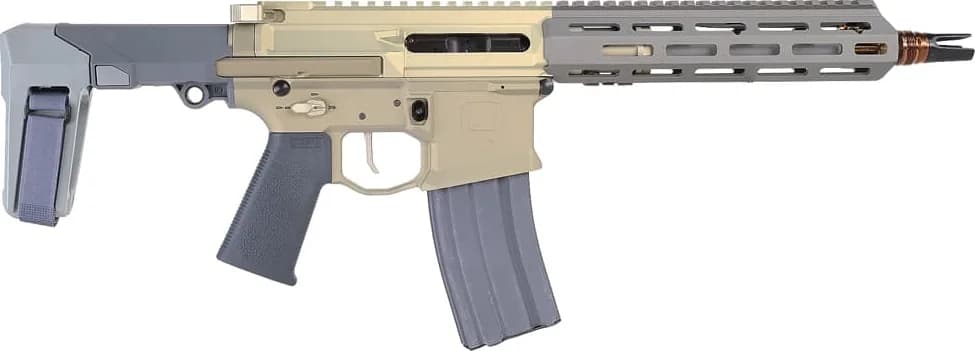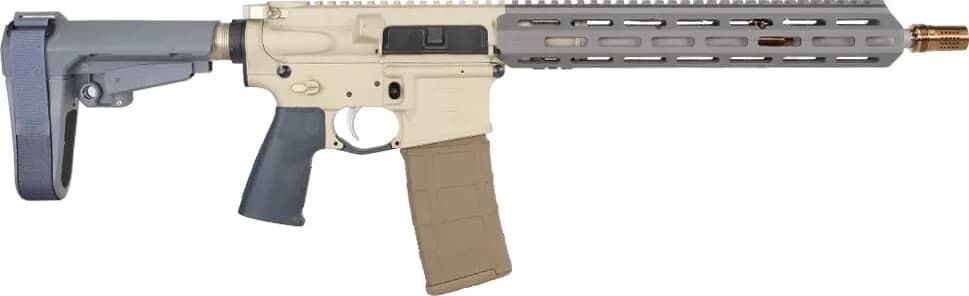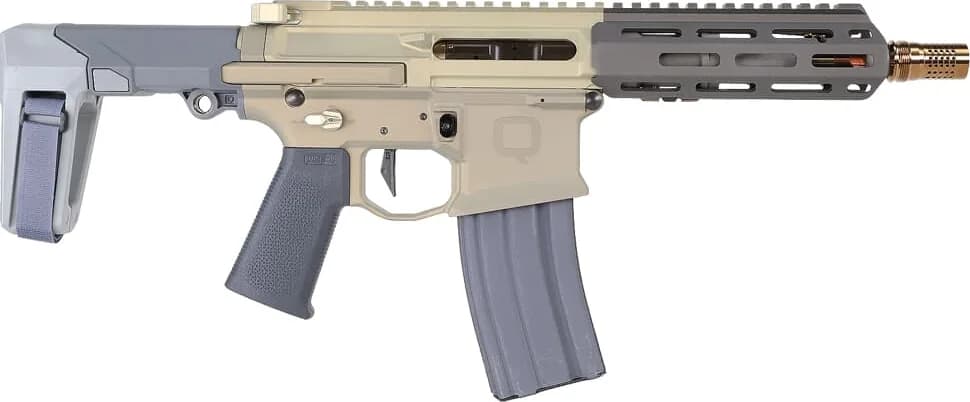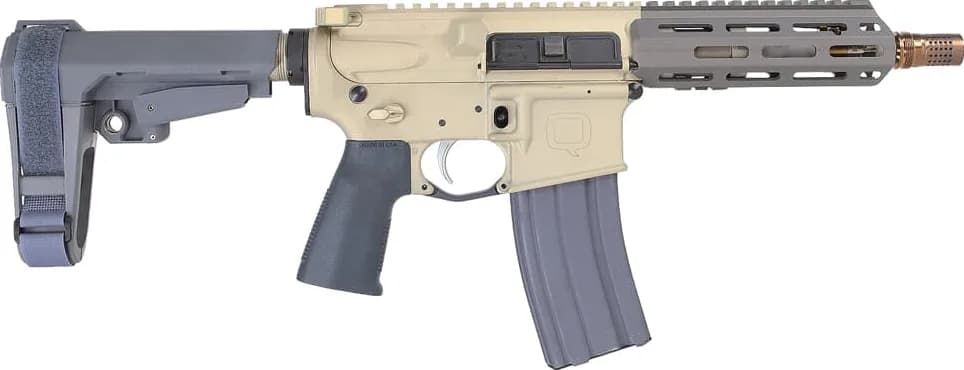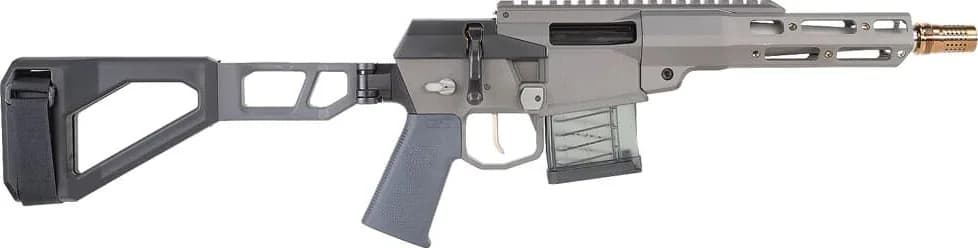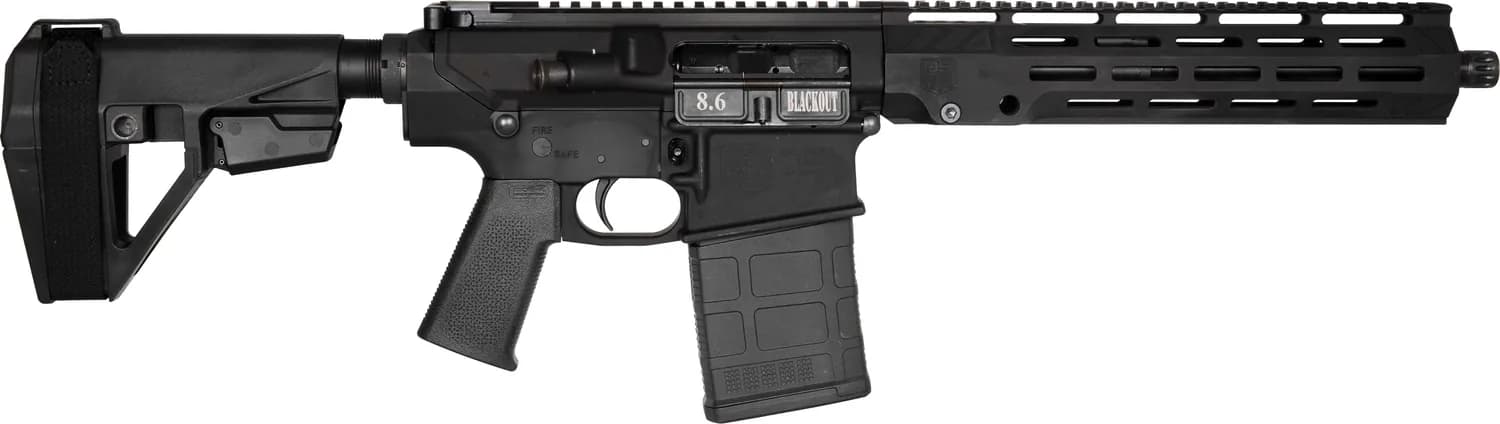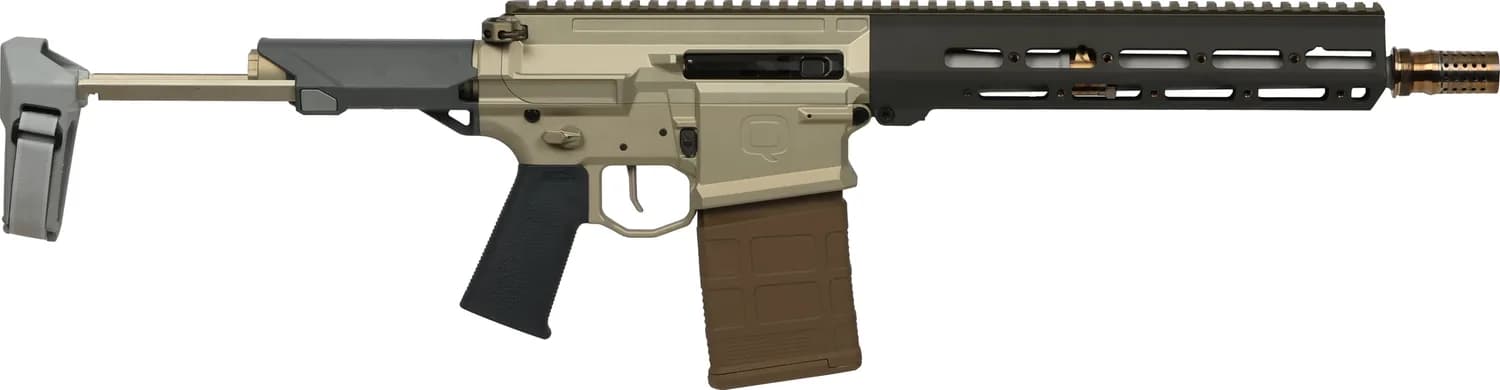
2-Stage Match Trigger, Pistol Brace, Picatinny Rail, MLOK Handguard
When Q unveiled the Boombox it was positioned as the company’s answer to a demand for a compact, high‑energy platform optimized around its new 8.6 Blackout cartridge. The Boombox concept first surfaced in industry previews mid‑2023 and moved into a formal commercial rollout over the following year as Q refined the platform and ammunition together. Q framed the Boombox as a “big brother” to the Honey Badger: a compact, fast‑handling system that brings substantially greater projectile mass and terminal effect to a short‑barrel package than traditional pistol‑caliber PDWs.
The Boombox was developed in parallel with the 8.6 Blackout cartridge itself, a centerfire round Q describes as a shortened 6.5 Creedmoor case necked to accept an 8.6 mm (≈.338 caliber) projectile. That cartridge was explicitly intended to give operators and shooters a platform that can run heavy, energy‑dense subsonic bullets from short barrels while still offering supersonic options for longer‑range work. Q’s marketing and early industry reporting presented the Boombox not only as a single gun but as a system: gun, barrel options, and ammunition designed to work together.
The Boombox is an AR‑pattern, large‑frame direct‑impingement design re‑engineered around the unique demands of 8.6 Blackout. Q’s engineering changes are focused on three linked goals: keep the package compact and light, ensure reliable operation with the high‑momentum projectiles the caliber uses, and make the platform modular so a single upper/bolt set can be adapted to different barrel lengths and calibers with minimal tooling. Among the specific choices reported during the launch and at industry events are a very fast rifling twist (the company cites a 1:3‑inch‑equivalent spin for the caliber), steel feed ramps, a rigid free‑float handguard/Q‑Sert interface, and a charging system and gas path revised to reduce failure points common to earlier short‑barrel large‑caliber AR designs. Q has also emphasized quick‑change barrel capability so the same bolt and magazine family can host different barrels and calibers.
On the furniture side, commercial Boombox pistol variants delivered to dealers have been shown with features more commonly found on modern tactical rifles: two‑stage match triggers, long Picatinny rails for optics, M‑LOK‑compatible handguards for accessory mounting, and pistol‑brace or folding‑brace arrangements for control in the braced pistol category. Dealer and trade listings for early Boombox configurations list 12‑inch and longer barrels, SR‑25 pattern magazines and options for folding or SB‑type stabilizing braces. Those choices reflect Q’s intent to marry large‑caliber ballistics with close‑quarters maneuverability.
In handling, the Boombox trades the lightness and low recoil of smaller PDWs for the mass and momentum of heavier projectiles. That’s manifested in a package that—while compact—still has substantial heft and a different recoil impulse. Q’s engineering emphasis on a rigid top rail and revised recoil/gas components appears aimed at managing those forces so the Boombox tracks well for follow‑up shots and holds zero under accessory load.
Because the Boombox was developed in lockstep with 8.6 Blackout, much of the platform’s performance conversation centers on ammunition behavior. Q and early press coverage have promoted the idea that a properly tuned 12‑inch Boombox can deliver tight groups and repeatable performance with the right projectiles, and the company has publicly claimed MOA‑level accuracy at extended ranges for the system when using its matched ammunition. Independent hands‑on impressions from industry events and range demonstrations have been enthusiastic about suppressed subsonic performance and the visceral terminal effect of heavy monolithic projectiles, while also noting that the recoil impulse is unlike that of a 5.56‑based PDW—heavier and more abrupt.
Reviewers who have fired Boombox prototypes and early production guns at trade events praised its suppressed sound profile with subsonic loads and its mechanical reliability under demonstration conditions, though long‑term durability data from open‑range consumer testing is still limited in the public record. The Boombox’s two‑stage trigger has been described as predictable and shooter‑friendly, but reviewers also emphasize that ammunition choice matters more with 8.6 Blackout than with many more mature cartridges: the fast twist and heavy bullets demand purpose‑made projectiles for consistent expansion and stabilization.
Where the Boombox excels is a fairly narrow but meaningful niche: it is a “heavy PDW” or short‑barrel battle rifle meant for suppressed subsonic work at close and intermediate ranges, with the option to switch to supersonic ammunition for extended reach without changing the platform. That makes it attractive to shooters who want a compact, suppressor‑friendly host that can deliver substantial terminal energy—operators, hunters working in heavy cover with suppressed subsonic loads, and enthusiasts who prize novel, high‑mass subsonic performance.
Its limitations are equally clear. The specialized 8.6 Blackout cartridge is newer and less widely available than established rifle and pistol rounds, so logistics and ammunition cost are considerations. The Boombox also carries more recoil and mass than pistol‑caliber PDWs, and its short‑barrel/suppressed subsonic sweet spot places constraints on supersonic performance compared with longer‑barrel rifles. Those tradeoffs make the Boombox less appropriate as an everyday defensive carry gun for most people and more of a purpose‑built tool or enthusiast platform.
The Boombox sits in an unusual market position. It’s not a direct competitor to lightweight AR‑15 pistols or to full‑size AR‑10 precision rifles; instead it occupies territory between PDWs, compact .308/6.5 platforms, and integrally suppressed “tactical” short‑barrel rifles. That novelty is a double‑edged sword: it gives Q a unique product that draws attention and early adopter interest, but it also sets a high bar for perceived value because buyers must accept a proprietary cartridge ecosystem and the premium that accompanies a novel, highly engineered platform.
Industry coverage has generally positioned the Boombox as an innovative, premium offering—one that will appeal to shooters who value capability and engineering over economy—rather than as a mass‑market value play. Comparisons in press write‑ups frequently put the Boombox alongside niche, high‑end PDW/personal defense platforms and suppressed hosts rather than commodity ARs; the common refrain is that the Boombox is interesting and potentially game‑changing if you accept its specific tradeoffs.
For buyers, the decision comes down to use case and ecosystem: those who want compact suppressed knockdown power in a single, well‑engineered package will find the Boombox compelling. Shooters wanting the broadest ammo availability, the lightest recoil, or the best price‑to‑performance ratio in the AR space will likely look elsewhere.
The Boombox is a clear statement from Q: the company is willing to design a cartridge and an entire firearm around a single performance goal. The result is a distinctive firearm that pushes the boundaries of what a compact, short‑barrel platform can do—but it asks buyers to accept the realities of a new cartridge family and a platform optimized for a particular set of tasks.
Start with a practical guide if you want a faster way to narrow the field before comparing specific models.
Learn how to choose the right handgun for home defense based on safety, ease of use, and practical everyday considerations.
Read guideComparison-focused shoppersA practical guide to comparing handguns the right way: what actually matters, what to ignore, and how to use comparison tools effectively.
Read guideFirst-time buyersLearn how to choose your first handgun by focusing on size, comfort, ease of use, and budget instead of getting lost in unnecessary details.
Read guide