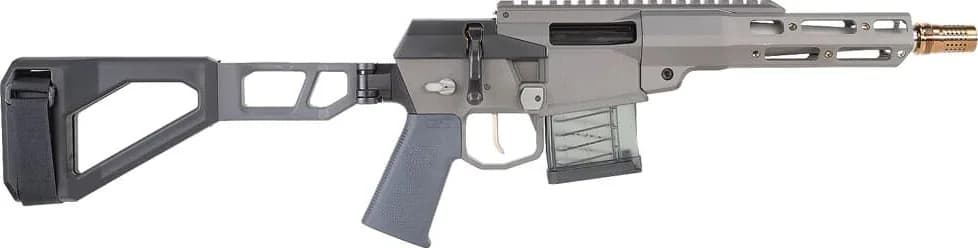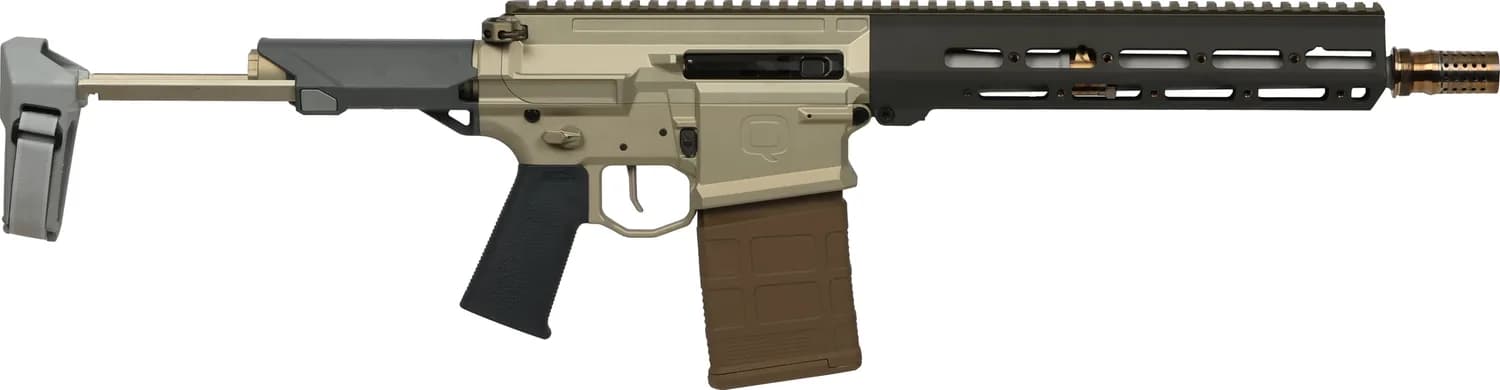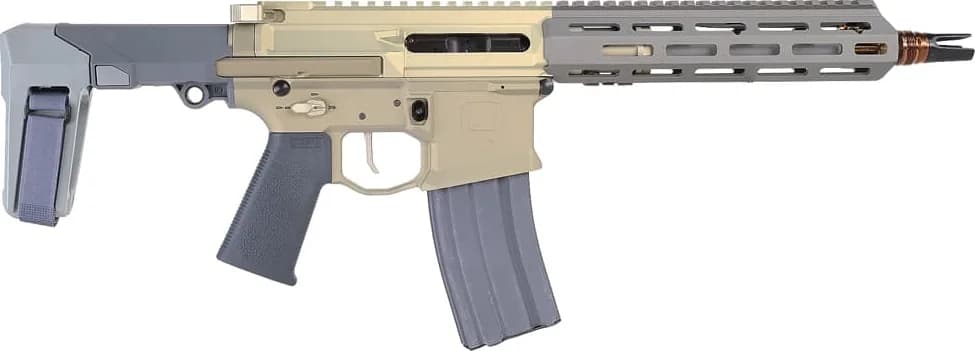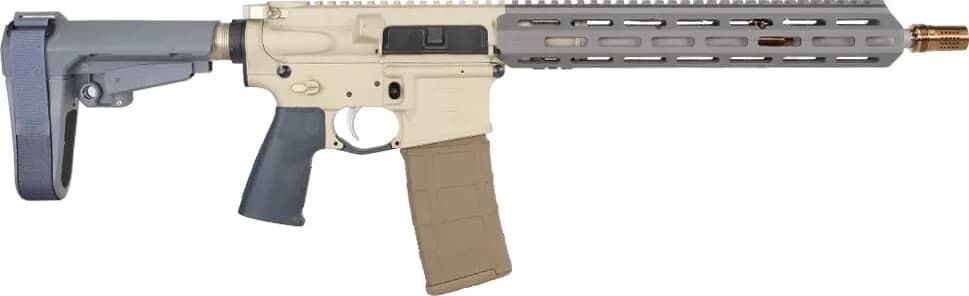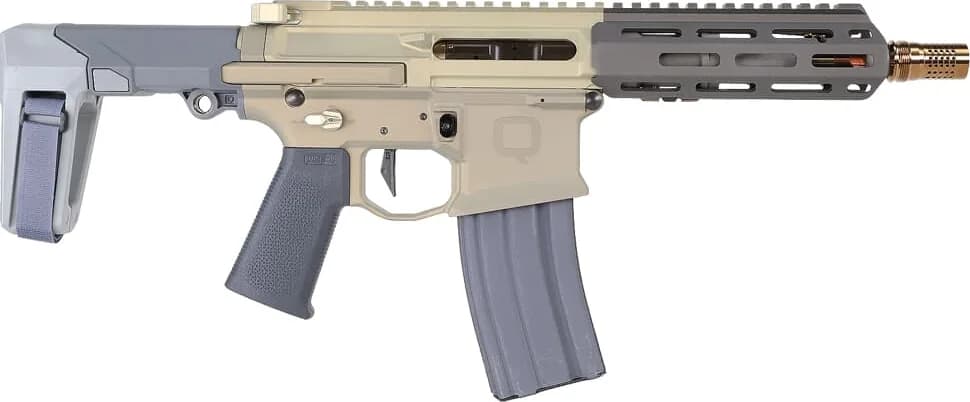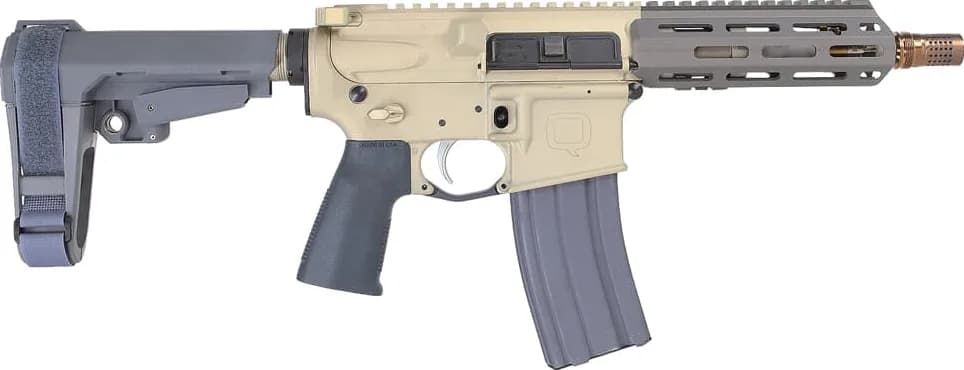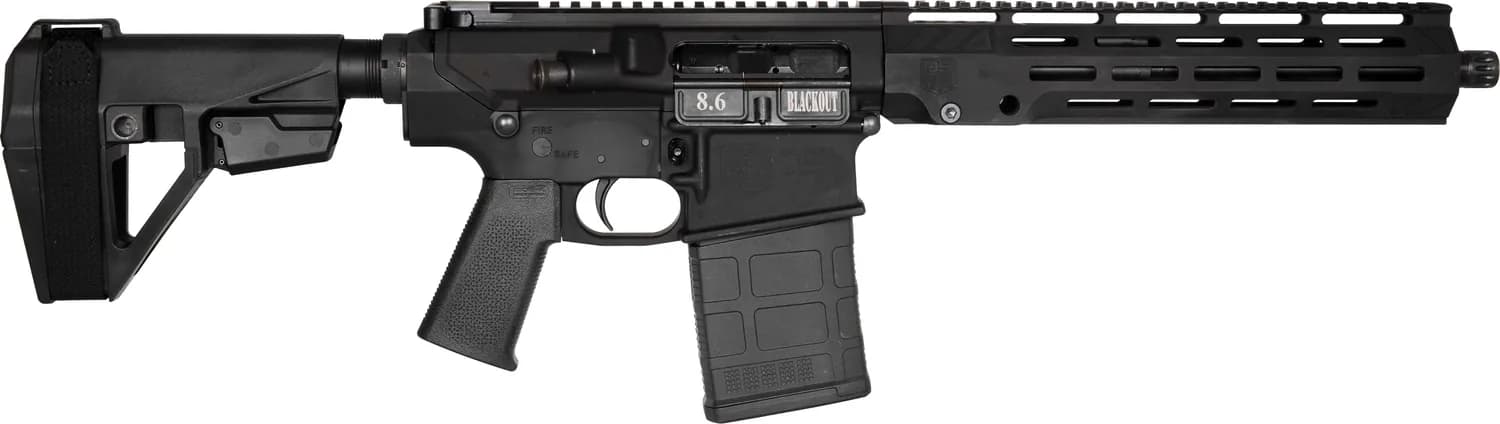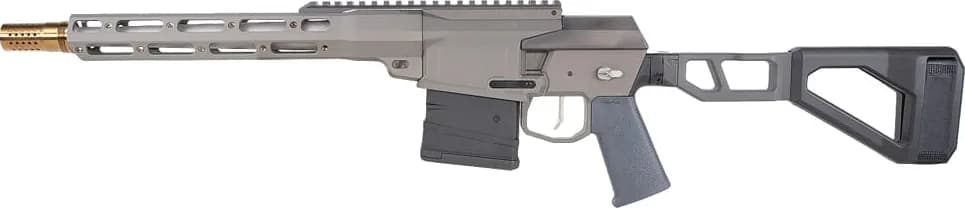
Folding Brace, 2-Stage Match Trigger, Picatinny Rail, Q-Sert Handguard
The Fix pistol is a compact, bolt‑action variant of Q LLC’s modular Fix platform, a family of single‑shot/ magazine‑fed bolt guns that Q introduced as a lightweight, collapsible alternative to conventional bolt‑action chassis rifles. The company’s user manual and printed materials trace the Fix project back several years and the Fix family appears in Q’s documentation as early as 2019, when the platform was established as a one‑piece receiver, folding‑stock bolt action intended for hunters, competitors and “armed professionals.”
Over time Q expanded the Fix lineup to include multiple barrel lengths and calibers, including the relatively new 8.6 Blackout cartridge. That chambering — developed within the same Q ecosystem as a larger, suppressed‑optimized analogue to .300 AAC Blackout — has become a headline option for the Fix because it blends heavy subsonic performance with the potential for suppressed supersonic use. Q and the wider community have positioned the Fix as a compact, suppressor‑friendly bolt gun for hunting and field work as well as for enthusiasts who want an AR‑style control scheme in a bolt action package.
The Fix is notable first for its monolithic, one‑piece aluminum receiver that houses the bolt, fire control and barrel interface. That single‑piece approach is intended to preserve rigidity while trimming weight when compared to traditional receiver/chassis assemblies. The platform borrows AR‑style ergonomics — familiar selector, magazine interface and pistol grip — while employing a 45° bolt‑throw and a two‑stage match trigger. The manual also documents a continuous Picatinny top rail, a Q‑Sert handguard interface and a folding, adjustable stock or brace on the pistol models.
Measured on the range, those specifications translate to a gun that wants to be carried and used like a light field rifle rather than a heavy precision rig. The short forend, compact overall length with the stock folded, and light receiver work together to make the Fix pistol easy to pack and maneuver. The one‑piece receiver and barrel‑to‑bolt locking design aim to keep barrel alignment and repeatability good for a lightweight platform, but the small package also amplifies handling tradeoffs: shorter barrels and lighter mass increase perceived recoil and raise the sensitivity of zero to barrel harmonics and ammunition selection.
Functionality details from the manual — SR25/AR‑pattern magazine compatibility, user‑adjustable cheek weld and LOP, and modular handguard mounting — reinforce a design philosophy built around modularity and upkeep in the field. The Fix uses a consistent T‑25 torque/wrench standard across fasteners to simplify disassembly and service.
Published reviews and owner reports paint a mixed but consistent picture. Some media reviewers praise the Fix’s engineering, light weight and AR‑style ergonomics, noting that it is a cleverly executed hybrid that fills a narrow niche between ultralight hunting rifles and precision chassis systems. Independent writeups have highlighted the crisp two‑stage trigger and the convenience of a folding, adjustable interface for carry and hunting.
At the same time, community reporting — the most numerous source of hands‑on data for the Fix — tends to emphasize variability. Owners and forum reviewers commonly report that the Fix can shoot well but is more “tuned” to specific ammunition and barrel lengths than heavier bolt guns. Accuracy reports range from sub‑MOA groups in ideal combinations to several‑MOA results with unlucky ammo/barrel pairings; a frequently cited theme is that the Fix often needs careful load development to show its best. Some shooters have also noted bolt‑binding or feel issues after barrel swaps or in certain builds, and a minority of users have reported inconsistent trigger or ignition behavior that required service. Many of the community comments also praise Q’s responsiveness when warranty support is necessary, even as they discuss occasional quality control episodes.
For the 8.6 Blackout chambering specifically, users applaud its suppressed subsonic performance and pairing with compact suppressors developed for the cartridge, but they also point out that short barrels and the heavy bullets typical of the caliber make ammunition choice and barrel length important drivers of accuracy and felt recoil.
Where the Fix pistol excels is compact, practical field use: backpack hunting, suppressed short‑range work, truck‑gun duties where a foldable, magazine‑fed bolt gun is preferred, and recreational range time for shooters who like the feel of an AR while using a bolt lockup. Its light weight and stowability make it appealing for hunters who want a knockdown big‑game cartridge in a short, packable rifle, and the 8.6 Blackout option increases stopping power with suppressed subsonics compared with smaller blackout‑style rounds.
The platform is less well‑suited to heavy precision work. For long‑range, match‑grade applications, buyers generally prefer heavier, stiffer barrels and chassis systems designed to minimize harmonic and thermal shifts over long strings of fire. The Fix’s advantages — light weight and compactness — come with corresponding compromises in heat absorption, harmonic stability and sensitivity to ammunition selection. Also, because the Fix uses SR‑pattern magazine fitments and a specific one‑piece receiver geometry, significant aftermarket modification is more limited than on standard AR or modular chassis systems.
The Fix sits in a small but growing segment of premium, boutique bolt guns that trade traditional heavy‑barrel precision for packability, unique ergonomics and modularity. In general discussion it is compared to lightweight hunting and field chassis rifles and to entry‑level precision rifles like those from Bergara, Howa and Ruger’s precision lines; community commentary tends to say that while you can buy rifles with tighter inherent accuracy for the same money, the Fix offers a particular combination of form factor and controls that those alternatives do not. Prospective buyers often frame the decision as one between raw accuracy per dollar versus a compact, highly usable package that is ready for suppressed hunting or expedition work.
Reputation‑wise, the Fix is polarizing: enthusiasts praise its originality, machining quality and niche fit, while some critics question Q’s pricing and note variability in out‑of‑the‑box accuracy and occasional QC stories reported by the user base. Those debates appear in review outlets, marketplace listings and broad forum discussion; they form a reliable part of the Fix’s public profile.
For buyers who value a lightweight, compact bolt gun with AR‑style controls and the option to run heavy subsonic 8.6 Blackout loads suppressed, the Fix pistol represents a compelling — if not universally economical — option. For those whose first priority is out‑of‑the‑box long‑range precision or maximal value per performance dollar, more traditional chassis or barreled actions remain attractive alternatives.
Start with a practical guide if you want a faster way to narrow the field before comparing specific models.
Learn how to choose the right concealed carry handgun based on size, comfort, safety, and everyday usability.
Read guideHome-focused buyersLearn how to choose the right handgun for home defense based on safety, ease of use, and practical everyday considerations.
Read guideComparison-focused shoppersA practical guide to comparing handguns the right way: what actually matters, what to ignore, and how to use comparison tools effectively.
Read guide